

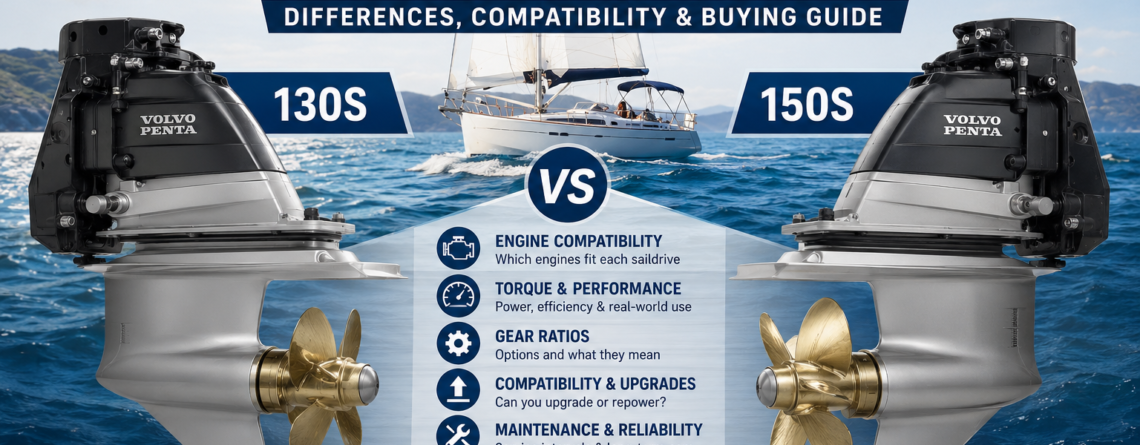
When most sailboat owners start researching a replacement saildrive, they usually focus on one question:
“Which one is better—the Volvo Penta Saildrive 130S vs 150S?”
It’s a fair question.
But after years of helping customers at Rong Marine select Volvo Penta Marine Engines, complete Volvo Penta Saildrive Systems, and marine engine repower packages, we’ve learned that it’s actually the wrong place to start.
The better question is:
“Which saildrive is right for my boat?”
That small change in thinking can save thousands of dollars, prevent compatibility issues, and make a noticeable difference in how your sailboat performs over the next ten or twenty years.
One of the biggest misconceptions in the sailing community is that the larger saildrive automatically delivers better performance.
In reality, choosing the wrong saildrive—even if it’s technically more capable—can result in poor propeller matching, unnecessary engine loading, reduced marine fuel efficiency, and expensive installation modifications.
At Rong Marine, we’ve seen customers who were convinced they needed to replace a perfectly suitable Volvo Penta 130S Saildrive with a Volvo Penta 150S Saildrive, only to discover after a detailed assessment that their existing setup was already the ideal match for their boat.
On the other hand, we’ve also worked with offshore cruisers whose growing displacement, additional cruising equipment, and engine upgrades meant that moving to the 150S was absolutely the right long-term decision.
That’s why this guide isn’t about declaring one saildrive “better.”
It’s about helping you understand the differences between the two, where each excels, and how to choose the saildrive that matches your engine, your hull, and your sailing ambitions.
Whether you’re replacing a worn saildrive, planning a marine engine repower, purchasing a cruising yacht, or researching Volvo Penta sailboat engines, this guide will help you make an informed decision based on real-world ownership—not just technical specifications.
Throughout this guide, you’ll learn:
- The differences between the Volvo Penta 130S Saildrive and Volvo Penta 150S Saildrive
- Which Volvo Penta Marine Engines each model supports
- Compatibility considerations
- Gear ratio differences
- Maintenance requirements
- Repower recommendations
- Offshore cruising suitability
- Which saildrive is likely the better investment for your sailing style
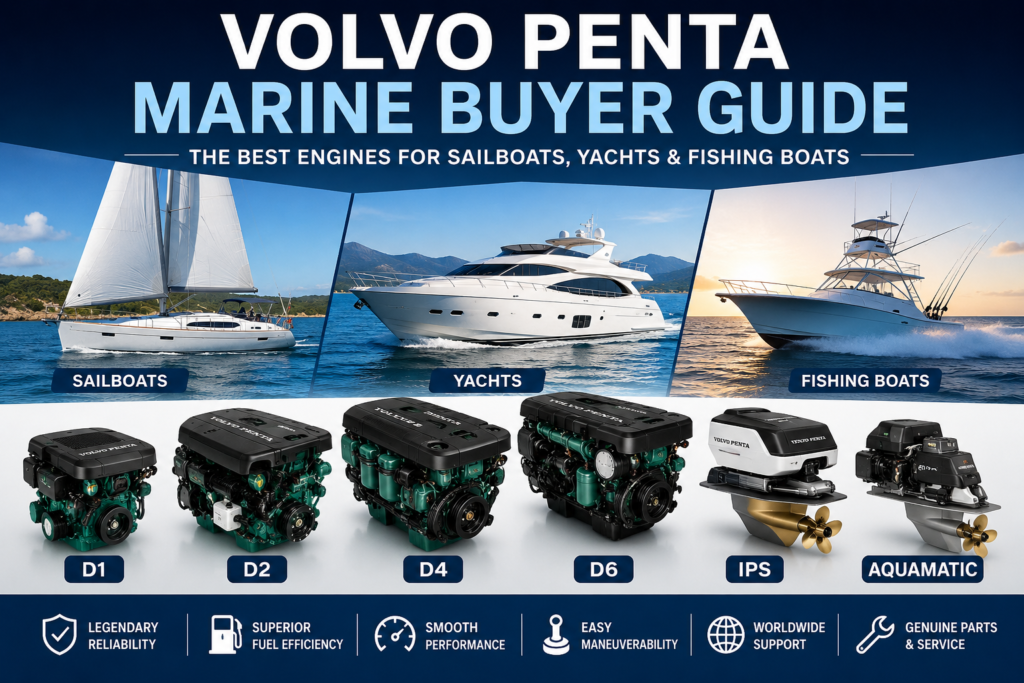
Why Choosing the Right Saildrive Matters More Than Most Owners Realize
When people think about sailboat performance, they usually picture the engine.
Horsepower.
Torque.
Fuel consumption.
While those are important, the Volvo Penta Saildrive sitting beneath your boat plays an equally important role.
The saildrive transfers engine power into efficient forward motion while influencing:
- Acceleration
- Cruising efficiency
- Propeller performance
- Vibration levels
- Noise
- Reverse maneuverability
- Long-term reliability
Think of it this way.
Installing the wrong saildrive is a little like fitting the wrong gearbox to a car.
The engine may be perfectly healthy, but if the transmission doesn’t suit the vehicle, performance suffers.
Exactly the same principle applies to Volvo Penta Saildrive Systems.
A Conversation We Have Almost Every Week
One discussion stands out because it perfectly illustrates why experience matters.
A customer contacted Rong Marine after purchasing a used cruising yacht.
The boat was fitted with a Volvo Penta D2 Marine Engine and a 130S Saildrive.
His first assumption was simple:
“The previous owner should have installed a 150S.”
He believed upgrading to the larger saildrive would automatically improve offshore performance.
Instead of recommending an upgrade, we asked a series of questions.
How much cruising gear do you carry?
Where do you normally sail?
How many hours do you motor each season?
What propeller is currently installed?
What is the boat’s displacement?
After reviewing the boat, we reached an unexpected conclusion.
The existing 130S Saildrive was already correctly matched.
Rather than replacing the saildrive, we recommended fitting a different propeller better suited to his cruising profile.
Several months later, he emailed us.
The boat accelerated more smoothly.
Cruising RPM dropped slightly.
Fuel consumption improved.
Most importantly, he avoided replacing a saildrive that was never the problem.
That experience reinforces an important lesson.
Choosing the correct propulsion package is rarely about buying the biggest components.
It’s about matching every part of the system. Hull Seal Mounting Rubber – Fits Volvo Penta 110S-150S
Before We Recommend Any Saildrive
One thing that surprises many new customers is that we rarely begin by asking which saildrive they want.
Instead, we start by learning about the boat.
At Rong Marine, our consultation typically includes questions such as:
- Which Volvo Penta Marine Engine do you currently have?
- Is the boat used mainly for coastal cruising or offshore passages?
- What is the vessel’s displacement?
- How many engine hours do you typically run each year?
- Do you normally cruise fully loaded?
- Which propeller are you currently using?
- Are you planning an engine upgrade in the future?
- Is this a replacement project or a complete marine engine repower?
Those answers often determine the correct saildrive far more accurately than simply comparing horsepower ratings.
Understanding Volvo Penta Saildrive Systems
Before comparing the 130S and 150S, it’s worth understanding why Volvo Penta Saildrive Systems have become the preferred propulsion choice for so many modern sailing yachts.
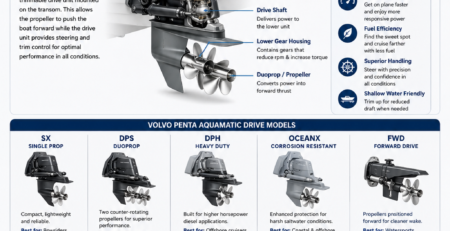
Unlike a traditional shaft drive, a saildrive combines the transmission and lower drive into one compact unit mounted vertically through the hull.
The engine sits close to the centerline of the boat, connecting directly to the saildrive.
Power then travels through the lower gearbox to the propeller.
This arrangement offers several important advantages.
Owners often notice:
- Reduced vibration
- Quieter operation
- Excellent weight distribution
- Efficient power transfer
- Better maneuverability
- Simpler engine alignment
These characteristics explain why Volvo Penta Saildrive Systems are widely used on production sailing yachts around the world.
Why Sailboat Builders Continue Choosing Saildrives
One question we occasionally hear is:
“If shaft drives have been around for so long, why do so many builders still choose saildrives?”
The answer comes down to design flexibility and efficiency.
Because saildrives require less space beneath the engine, designers have greater freedom when planning interior layouts.
They also reduce alignment complexity during installation.
For many modern cruising yachts, this means:
- Better accommodation layouts
- Lower vibration
- Improved onboard comfort
- Efficient propulsion
- Easier installation during production
These practical advantages explain why many leading yacht manufacturers continue specifying Volvo Penta Saildrive Systems as standard equipment.
Volvo Penta 130S Saildrive Explained
The Volvo Penta 130S Saildrive has earned an outstanding reputation among cruising sailors.
It has been installed on thousands of sailing yachts worldwide and continues to be a trusted choice for coastal cruising, club racing, and extended passage making.
One reason for its popularity is balance.
It provides sufficient strength for many smaller and mid-sized sailboats while remaining compact and efficient.
Typical applications include:
- Coastal cruising yachts
- Family sailboats
- Performance cruisers
- Weekend sailing boats
The 130S Saildrive is commonly paired with:
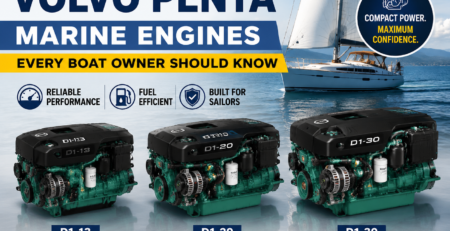
- Volvo Penta D1-13,
- Volvo Penta D1-20,
- Volvo Penta D1-30,
- Volvo Penta D2-40,
- Certain Volvo Penta D2-50 configurations
When matched correctly, this combination offers smooth propulsion, dependable reliability, and excellent marine fuel efficiency.
Why Owners Like the 130S
After speaking with hundreds of sailboat owners, several themes appear repeatedly.
Owners appreciate the 130S Saildrive because it delivers:
- Proven reliability
- Quiet operation
- Smooth shifting
- Efficient cruising
- Straightforward maintenance
- Long service life
Many also value its compatibility with folding and feathering propellers commonly used on cruising sailboats.
For owners whose boats fall within its intended operating range, the 130S often provides everything they need without introducing unnecessary complexity or expense.
That is one reason it remains one of the most respected Volvo Penta Saildrive Systems ever produced.
Volvo Penta 150S Saildrive Explained
If the Volvo Penta 130S Saildrive is known for its balance and versatility, the Volvo Penta 150S Saildrive is designed to handle the increased demands of larger sailing yachts and more powerful diesel engines.
At Rong Marine, we often recommend the 150S to customers who spend extended periods offshore, cruise with heavy loads, or are planning a marine engine repower that involves moving to a higher-output engine.
One thing we always explain is that the 150S isn’t simply a “bigger version” of the 130S.
It was engineered to accommodate greater engine torque and support larger cruising yachts while maintaining the smooth, quiet characteristics that sailors expect from Volvo Penta Saildrive Systems.
The 150S Saildrive is commonly paired with:
- Volvo Penta D2-55
- Volvo Penta D2-60
- Volvo Penta D2-75
These engine packages are frequently found in:
- Offshore cruising yachts
- Bluewater sailboats
- Larger production sailing yachts
- Performance cruising yachts
- Liveaboard cruising vessels
For sailors planning long-distance passages, the 150S offers the confidence that comes from having a propulsion system engineered for higher loads and extended operation.
Why Offshore Cruisers Often Choose the 150S
One of the biggest differences between coastal cruising and offshore sailing is consistency.
Offshore sailors often motor for long periods when wind conditions change.
The boat is heavier.
Fuel tanks are full.
Water tanks are full.
Additional equipment is carried onboard.
In these situations, the propulsion system works considerably harder.
This is where the 150S Saildrive demonstrates its strengths.
Customers who regularly undertake offshore passages often tell us they appreciate:
- Smooth power delivery
- Excellent cruising efficiency
- Strong low-speed maneuverability
- Reliable long-distance operation
- Confidence when operating under load
These benefits become especially valuable during extended cruising where reliability matters far more than headline performance figures.
Volvo Penta Saildrive 130S vs 150S
Now we arrive at the question that brings most readers here.
Which saildrive should you choose?
Rather than declaring one model superior, it’s far more useful to understand how they differ and which applications suit each one.
Engine Compatibility
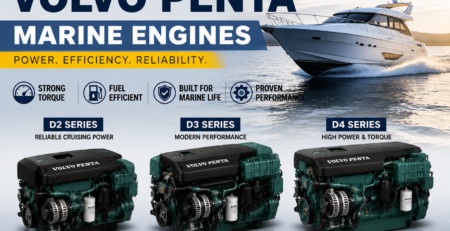
The 130S is typically matched with lower-output diesel engines such as the Volvo Penta D1 Marine Engines and smaller Volvo Penta D2 Marine Engines.
The 150S, on the other hand, is designed for higher-powered D2 engines that produce greater torque and are commonly installed in larger cruising yachts.
The first step in choosing between them is therefore ensuring compatibility with your engine.
Torque Capacity
Torque matters just as much as horsepower.
A saildrive must comfortably handle the twisting forces generated by the engine.
While both the 130S and 150S are durable systems, the 150S is intended for applications where higher torque output is expected.
Choosing a saildrive with insufficient torque capacity can reduce long-term reliability and increase wear on drivetrain components.
Boat Size
In general:
The 130S Saildrive is well suited to:
- Smaller cruising yachts
- Coastal sailing boats
- Performance cruisers
- Family sailboats
The 150S Saildrive is better suited to:
- Larger offshore yachts
- Heavier displacement vessels
- Long-distance cruising boats
- Liveaboard sailboats
Boat size alone doesn’t determine the correct saildrive, but it is an important part of the overall propulsion package.
Why Gear Ratios Matter More Than Most Buyers Think
When customers compare saildrives, they often focus on horsepower compatibility.
Experienced marine technicians usually begin somewhere else.
Gear ratio.
This is because the gear ratio determines how efficiently engine power is transferred to the propeller.
The correct ratio affects:
- Cruising speed
- Engine RPM
- Fuel consumption
- Propeller efficiency
- Engine loading
- Long-term durability
Selecting the wrong ratio can leave even an excellent engine feeling underpowered or inefficient.
That is why gear ratio selection should always be considered alongside engine choice and propeller sizing.
Compatibility Is More Than Engine Horsepower
At Rong Marine, we never recommend a saildrive based solely on the engine’s maximum output.
Instead, we evaluate the complete propulsion package.
This includes:
- Hull length
- Boat displacement
- Cruising speed
- Typical loading
- Propeller type
- Engine torque
- Intended operating conditions
Two sailboats equipped with identical Volvo Penta Marine Engines can still require different saildrive configurations because their hull designs and operating profiles are completely different.
This is one reason generic recommendations found online should always be treated with caution.
Can You Upgrade From a 130S to a 150S?
This is one of the most common questions we receive.
The short answer is:
Sometimes.
The longer answer is that compatibility depends on several technical factors.
Before recommending an upgrade, we evaluate:
- Existing engine
- Engine mounts
- Hull structure
- Saildrive opening
- Propeller compatibility
- Boat displacement
- Future cruising plans
In some cases, upgrading to the 150S makes excellent sense.
In others, retaining the 130S and optimizing the propeller delivers better value.
Every boat deserves an individual assessment.
Offshore Performance Comparison
Many sailors assume the 150S automatically delivers better offshore performance.
The reality is more nuanced.
For a smaller coastal cruiser powered by a Volvo Penta D1 Marine Engine, the 130S Saildrive may already provide ideal performance.
Installing a larger saildrive would not necessarily improve handling or efficiency.
Conversely, a heavily loaded bluewater yacht equipped with a Volvo Penta D2-75 is likely to benefit from the additional capacity of the 150S.
This is why we always emphasize matching the propulsion package rather than selecting components independently.
Fuel Efficiency
One of the biggest advantages of correctly matched Volvo Penta Saildrive Systems is excellent marine fuel efficiency.
However, it’s important to understand that fuel economy depends on several factors working together.
These include:
- Hull design
- Saildrive selection
- Gear ratio
- Propeller sizing
- Engine operating RPM
- Boat loading
- Sea conditions
Simply changing from a 130S to a 150S does not automatically reduce fuel consumption.
In fact, an incorrectly matched saildrive can sometimes decrease efficiency.
Our advice is always to evaluate the complete propulsion package before making changes.
A Lesson We Often Share
One customer planned to replace both his engine and saildrive while preparing his yacht for Mediterranean cruising.
His original plan was straightforward:
Install the largest engine and the largest saildrive that would physically fit.
Instead, we discussed how he actually used the boat.
He rarely carried heavy loads.
Most trips were between marinas.
Annual engine hours were relatively low.
After reviewing the project, we recommended a smaller propulsion package that better matched the boat’s displacement and cruising style.
Nearly a year later, he contacted us again.
His message was simple:
“I’m glad we didn’t buy more than the boat needed.”
That experience reinforces one of the most important principles we follow at Rong Marine.
The best propulsion system is rarely the largest.
It’s the one that’s properly matched to the boat. Choosing your boat bilge pump – DAM Marine Guide
Maintenance Comparison: Volvo Penta 130S vs 150S
One of the biggest questions we receive after helping customers choose between the Volvo Penta 130S Saildrive and Volvo Penta 150S Saildrive is surprisingly simple:
“Which one is cheaper to maintain?”
The honest answer is that neither saildrive is inherently expensive to own when it’s maintained properly.
At Rong Marine, we’ve worked with customers who have operated both models reliably for well over a decade. The common factor wasn’t luck—it was consistent preventative maintenance.
Both Volvo Penta Saildrive Systems follow similar maintenance principles, including:
- Regular gear oil changes
- Saildrive seal inspections
- Anode replacement
- Propeller inspection
- Cooling water intake checks
- Bellows and diaphragm inspections (where applicable)
- Corrosion monitoring
- Annual professional servicing
The maintenance schedule is straightforward, but consistency is critical.
Ignoring routine inspections can quickly become far more expensive than performing preventative maintenance.
The Importance of Saildrive Seals
If there is one component every sailboat owner should understand, it is the saildrive seal.
These seals create the watertight barrier between the saildrive and the hull.
Although modern Volvo Penta Saildrive Systems are engineered for durability, seals are service items and should never be ignored.
At Rong Marine, one of the most common recommendations we make during annual servicing is to inspect the condition of the saildrive sealing system rather than waiting for visible signs of wear.
Replacing a seal during scheduled maintenance is significantly less disruptive—and less costly—than dealing with water ingress or an unexpected haul-out.
Corrosion Protection Matters
Saltwater is one of the harshest environments any propulsion system can face.
Whether your boat is equipped with a 130S or a 150S, corrosion prevention should be part of every maintenance routine.
This includes:
- Inspecting sacrificial anodes
- Monitoring protective coatings
- Flushing systems where appropriate
- Cleaning marine growth
- Inspecting electrical bonding systems
We’ve seen saildrives with thousands of reliable operating hours because owners paid close attention to corrosion prevention.
We’ve also seen relatively new drives suffer avoidable damage simply because anodes weren’t replaced on time.
Why Genuine Volvo Penta Parts Make a Difference
One topic that frequently comes up during service consultations is whether aftermarket components are a suitable alternative.
For some non-critical items, owners may choose aftermarket options. However, when it comes to major propulsion components, we generally recommend using genuine Volvo Penta parts.
The reasons are practical rather than promotional.
Genuine parts are engineered for:
- Precise fitment
- Material compatibility
- Long-term durability
- Manufacturer performance standards
When you’re relying on your saildrive during a coastal passage or offshore crossing, confidence in your propulsion system becomes far more valuable than small upfront savings.
Common Problems Owners Encounter
Both the 130S and 150S have earned strong reputations for reliability, but like any marine equipment, they can experience issues if neglected.
Some of the most common service items we encounter include:
Volvo Penta 130S
- Worn anodes
- Delayed gear oil changes
- Propeller damage from groundings
- Corrosion caused by inadequate maintenance
- Seal wear after extended service intervals
Volvo Penta 150S
- Similar routine service items
- Increased wear when paired with oversized propellers
- Higher loads on heavily equipped cruising yachts
- Damage caused by incorrect engine matching
It’s worth noting that these are not design flaws.
In most cases, they are the result of deferred maintenance, incorrect setup, or normal wear over time.
Dealer Tip: Propellers Matter More Than Many Owners Think
One of the easiest mistakes to make is assuming that replacing the saildrive will solve every performance issue.
In reality, the propeller is often just as important.
We’ve worked with customers who were convinced they needed a new Volvo Penta Saildrive when the real issue was an incorrectly matched propeller.
After selecting a propeller better suited to their engine, gear ratio, and cruising profile, they experienced:
- Better acceleration
- Lower cruising RPM
- Improved marine fuel efficiency
- Smoother maneuvering
- Reduced engine load
Sometimes the most effective upgrade isn’t replacing the drive—it’s optimizing the entire propulsion package.

Repowering With a Volvo Penta Saildrive
Repowering has become increasingly popular as many well-built sailing yachts continue to provide excellent service despite aging propulsion systems.
Rather than replacing the boat, owners often choose to install a modern Volvo Penta Marine Engine and evaluate whether the existing saildrive remains suitable.
This decision should never be based solely on horsepower.
Before recommending a marine engine repower, we evaluate:
- Hull condition
- Engine beds
- Existing saildrive
- Gear ratio
- Boat displacement
- Weight distribution
- Cruising profile
- Future ownership plans
A successful repower is about creating a balanced propulsion system—not simply installing a larger engine.
Should You Replace the Saildrive During a Repower?
This is another question we hear frequently.
The answer depends on the condition of the existing saildrive.
If the drive has been properly maintained and remains compatible with the new engine, replacement may not be necessary.
However, replacing the saildrive can make sense when:
- Upgrading to a more powerful engine
- Changing gear ratios
- Addressing long-term wear
- Simplifying future maintenance
- Improving compatibility with modern propulsion components
Every repower project should be evaluated individually.
So, Which Saildrive Should You Buy?
After comparing the two models, many readers expect a simple recommendation.
The truth is that both the Volvo Penta 130S Saildrive and the Volvo Penta 150S Saildrive are excellent products.
The better choice depends entirely on your application.
Choose the 130S If:
- You own a smaller or mid-sized cruising sailboat.
- Your engine falls within the recommended compatibility range.
- You prioritize simplicity, efficiency, and proven reliability.
- Your current propulsion package is already well matched.
Choose the 150S If:
- You operate a larger cruising yacht.
- Your boat carries significant offshore equipment.
- You’re installing a higher-output Volvo Penta D2 Marine Engine.
- You expect greater torque demands during long-distance cruising.
Neither model is universally better.
The right choice is the one that complements your boat, your engine, and the way you actually sail.
Frequently Asked Questions
What is the difference between the Volvo Penta 130S and 150S?
The primary differences relate to engine compatibility, torque capacity, and intended applications. The 150S is designed for larger engines and heavier cruising yachts, while the 130S is commonly used on smaller and mid-sized sailing boats.
Which saildrive is more reliable?
Both have excellent reliability records when maintained according to Volvo Penta’s recommended service schedule.
Can I upgrade from a 130S to a 150S?
In many cases, yes—but compatibility depends on your hull, engine, gear ratio, and overall propulsion package. A professional assessment is recommended before making changes.
Which engines fit the 130S?
The 130S is commonly paired with:
- Volvo Penta D1-13
- Volvo Penta D1-20
- Volvo Penta D1-30
- Volvo Penta D2-40
- Some Volvo Penta D2-50 installations
Which engines fit the 150S?
The 150S is typically matched with:
- Volvo Penta D2-55
- Volvo Penta D2-60
- Volvo Penta D2-75
How long do Volvo Penta Saildrives last?
With proper maintenance, regular inspections, and the use of genuine Volvo Penta parts, both the 130S and 150S are capable of providing many years of dependable service.
Why Sailboat Owners Choose Rong Marine
Buying a saildrive is about far more than purchasing a gearbox.
It’s about creating a propulsion system that will deliver dependable performance for years to come.
At Rong Marine, we help customers worldwide with:
- Volvo Penta Saildrive Systems
- Volvo Penta Marine Engines
- Saildrive compatibility assessments
- Marine engine repower planning
- Genuine Volvo Penta parts
- Technical guidance
- Worldwide shipping
- Long-term product support
Our recommendations are based on practical experience gained from helping sailing yacht owners, boatyards, and marine professionals—not simply comparing specification sheets.
That approach allows us to provide balanced advice focused on long-term ownership rather than short-term sales.
Final Thoughts
The comparison between the Volvo Penta 130S Saildrive and the Volvo Penta 150S Saildrive isn’t about deciding which product is better.
It’s about understanding which one is right for your boat.
Throughout this guide, we’ve seen that the best propulsion system is determined by more than horsepower or model number.
It depends on:
- Engine compatibility
- Gear ratios
- Hull design
- Boat displacement
- Cruising style
- Maintenance planning
- Long-term ownership goals
At Rong Marine, we’ve learned that the most satisfied owners are not the ones with the biggest engines or the newest equipment.
They’re the ones whose propulsion systems are properly matched from the beginning.
Take the time to evaluate the complete package, ask the right questions, and seek expert guidance before making your decision.
The result will be a sailboat that performs more efficiently, operates more smoothly, and gives you greater confidence every time you leave the marina.


Leave a Reply