

When most boat owners begin shopping for a new propulsion package, they naturally focus on the engine.
How much horsepower does it produce?
How fast will the boat go?
How fuel efficient is it?
Those are all important questions, but after years of helping customers at Rong Marine choose the right marine propulsion systems, we’ve discovered that experienced boat owners eventually ask a different question:
“Which propulsion system will make me enjoy my boat more?”
That question shifts the conversation away from horsepower alone and toward something much more important—the complete boating experience.
Because the truth is, the engine may provide the power, but the propulsion system determines how that power reaches the water. It influences acceleration, handling, docking, fuel efficiency, cruising comfort, maintenance requirements, and even how confident you feel behind the helm.
This is exactly why Volvo Penta Aquamatic Sterndrive Systems have remained one of the most respected innovations in recreational boating for more than six decades.
At Rong Marine, we’ve helped customers compare Volvo Penta Aquamatic, Volvo Penta IPS, traditional shaft drives, and other marine propulsion systems for everything from family cruisers and offshore fishing boats to luxury yachts and commercial vessels. One thing has remained remarkably consistent over the years:
The happiest boat owners are rarely those with the biggest engines.
They’re the ones who selected the propulsion system that best matches the way they actually use their boat.
Whether you’re considering a new installation, researching Volvo Penta engines for sale, planning a marine engine repower, or simply trying to understand how Aquamatic sterndrives compare with modern propulsion technologies, this guide will walk you through everything you need to know before making an investment.
Throughout this article, you’ll learn:
- What Volvo Penta Aquamatic Sterndrive Systems are
- Why they revolutionized recreational boating
- How sterndrive technology works
- Which Volvo Penta diesel engines and gasoline engines are commonly paired with Aquamatic drives
- The advantages and limitations of sterndrives
- How Aquamatic compares with Volvo Penta IPS and shaft drives
- Maintenance and long-term ownership considerations
- How to determine whether Aquamatic is the right propulsion system for your boat.
Why Volvo Penta Aquamatic Changed Recreational Boating Forever
Every major industry experiences a breakthrough that changes customer expectations forever.
In aviation, fly-by-wire controls transformed aircraft handling.
In the automotive world, automatic transmissions and electronic stability systems changed the driving experience.
For recreational boating, many industry professionals consider the introduction of Volvo Penta Aquamatic Sterndrive Systems one of those defining moments.
Before Aquamatic, boat owners generally had two primary propulsion choices:
- Inboard shaft drives
- Outboard engines
Each had advantages, but both also came with limitations.
Shaft drives provided dependable power but often required more hull space and offered limited trim adjustment.
Outboards were versatile and easier to service but were not always the preferred solution for larger recreational boats.
Volvo Penta saw an opportunity to create something entirely different.
In 1959, the company introduced the world’s first commercially successful sterndrive system—a breakthrough that combined the advantages of both inboard and outboard propulsion.
The result was the birth of Volvo Penta Aquamatic.
More than sixty years later, Aquamatic remains one of the most recognized names in marine propulsion technology.
Real-World Experience From Rong Marine
One conversation with a customer perfectly illustrates why propulsion matters so much.
A gentleman visited us while shopping for a replacement cruiser.
He had already narrowed his choices to two boats.
Both used nearly identical Volvo Penta diesel engines.
Horsepower was virtually the same.
Fuel consumption figures looked similar.
On paper, the boats appeared almost identical.
The biggest difference?
One featured a traditional shaft drive.
The other was equipped with Volvo Penta Aquamatic Sterndrive Systems.
Rather than recommending either boat immediately, we encouraged him to sea trial both.
Several days later, he called us back.
His decision had already been made.
Interestingly, he didn’t begin talking about speed.
He didn’t mention horsepower.
Instead, he said something we hear surprisingly often:
“The Aquamatic boat just felt more enjoyable to drive.”
That sentence summarizes why so many owners continue choosing Aquamatic.
The experience on the water often matters more than the numbers printed in a brochure.
What Is Volvo Penta Aquamatic Marine Diesel Engines?
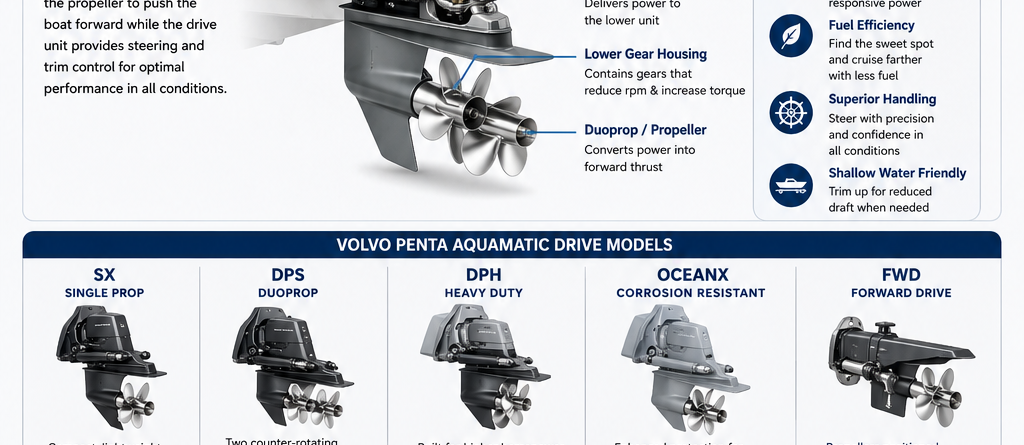
Simply put, Volvo Penta Aquamatic is a sterndrive propulsion system that combines an inboard engine with an externally mounted drive unit attached to the transom of the boat.
Unlike traditional inboard shaft drives, the sterndrive can be steered and trimmed.
This gives operators greater control over how the boat performs under different conditions.
The Aquamatic system typically consists of:
- The marine engine
- Transom assembly
- Upper gear housing
- Lower gear housing
- Drive shaft
- Hydraulic trim system
- Steering components
- Propellers
Together, these components create a highly efficient and responsive propulsion package.
Rather than functioning independently, they operate as one integrated system to transfer engine power into forward motion.
Why Boat Owners Continue Choosing Aquamatic
One question we often hear is:
“If Volvo Penta IPS marine propulsion systems exists today, why are so many manufacturers still producing boats with Aquamatic drives?”
The answer is simple.
Because Aquamatic continues to deliver an outstanding balance of:
- Performance
- Fuel efficiency
- Handling
- Simplicity
- Installation flexibility
- Long-term ownership value
Modern Volvo Penta Aquamatic Sterndrive Systems remain especially popular on:
- Express cruisers
- Bowriders
- Sport cruisers
- Cabin cruisers
- Performance boats
- Coastal fishing boats
For many owners, they provide exactly the level of performance and maneuverability they need without moving into more complex propulsion packages.
How Volvo Penta Aquamatic Sterndrive Systems Work
One reason Aquamatic performs so well is that it combines several technologies into one compact propulsion package.
Power begins with the engine.
Instead of transferring that power through a fixed propeller shaft beneath the hull, it travels through the transom assembly into the sterndrive.
The drive itself pivots for steering and trims up or down to optimize performance.
Because the entire drive changes direction, steering feels direct and responsive.
This is one of the reasons Aquamatic-equipped boats often feel more agile than traditional shaft-driven vessels.
Understanding Trim
If you’ve never owned a sterndrive boat before, trim may seem like a small feature.
In reality, it dramatically influences boat performance.
Adjusting trim changes the angle of the drive relative to the hull.
Proper trim can improve:
- Fuel efficiency
- Acceleration
- Top speed
- Ride comfort
- Planing performance
Experienced captains constantly adjust trim as sea conditions change.
It’s one of the reasons Aquamatic boats remain enjoyable to operate in a wide range of environments.
Better Weight Distribution
Another advantage of Volvo Penta Aquamatic Sterndrive Systems is how they distribute weight.
Because much of the propulsion equipment sits at the stern, designers often gain additional flexibility when planning cockpit layouts and interior accommodation.
This has contributed to the popularity of Aquamatic-equipped:
- Express cruisers
- Sport boats
- Family cruisers
- Weekend yachts
Many boat builders continue choosing Aquamatic because it allows them to combine excellent performance with practical onboard living space.
Why Boat Manufacturers Still Build Around Aquamatic
One misconception is that Aquamatic is older technology that has simply survived over time.
That isn’t accurate.
Boat manufacturers continue designing new models around Volvo Penta Aquamatic Sterndrive Systems because they offer practical advantages that remain highly relevant today.
These include:
- Compact propulsion packaging
- Excellent acceleration
- Adjustable trim
- Responsive handling
- Strong cruising efficiency
- Wide engine compatibility
At Rong Marine, we frequently work with customers comparing new and pre-owned boats.
Many are surprised to discover how many respected international boat builders still specify Aquamatic as the preferred propulsion system across multiple model ranges.
That continued manufacturer confidence says a great deal about the system’s long-term reputation.
The Major Benefits of Volvo Penta Aquamatic Sterndrive Systems
After helping boat owners compare propulsion options for many years, we’ve found that customers consistently mention the same advantages after moving to Aquamatic.
Rather than focusing solely on technical specifications, they talk about how the boat feels.
The benefits owners most frequently describe include:
- Quicker acceleration
- Easier planing
- Better fuel economy
- Comfortable cruising
- Responsive steering
- Improved maneuverability
- Greater confidence at the helm
Perhaps the biggest compliment we hear isn’t about speed at all.
It’s this:
“The boat simply feels easier to drive.”
For many recreational boat owners, that improvement alone makes every trip more enjoyable.
And ultimately, that’s what the best marine propulsion systems are designed to achieve—not just moving a boat through the water, but making every journey more comfortable, more efficient, and more enjoyable.
Volvo Penta Aquamatic Drive Models Explained
One of the biggest misconceptions we encounter at Rong Marine is that every Volvo Penta Aquamatic Sterndrive System is the same.
That isn’t the case.
Over the years, Volvo Penta has developed several Aquamatic drive families, each designed for different engines, boat sizes, operating environments, and performance expectations.
Understanding these differences helps buyers choose the right propulsion package rather than simply selecting the newest or most powerful drive.
Let’s look at the most common Aquamatic systems you’ll encounter.
Volvo Penta SX Drives
The Volvo Penta SX is one of the most widely recognized single-prop sterndrives in the Aquamatic family.
It has earned a reputation for reliability, smooth performance, and straightforward maintenance.
The SX drive is commonly paired with:
- Smaller Volvo Penta gasoline engines
- Entry-level recreational boats
- Bowriders
- Family sport boats
- Cabin cruisers
Owners appreciate the SX because it delivers:
- Responsive handling
- Efficient cruising
- Simple operation
- Good long-term durability
For recreational boating, it remains one of the most proven sterndrive systems available.
Volvo Penta DPS Duoprop Drives
If there is one Aquamatic drive that consistently impresses customers during sea trials, it is the Volvo Penta DPS Duoprop.
Instead of using a single propeller, the DPS features two counter-rotating propellers working together.
This creates several noticeable advantages.
Many owners report:
- Faster acceleration
- Quicker planing
- Better grip in turns
- Improved fuel efficiency
- More stable handling
One customer who upgraded from a single-prop drive summed it up perfectly:
“The boat doesn’t feel like it’s working as hard anymore.”
That is one of the greatest strengths of the Duoprop system.
Rather than simply increasing speed, it delivers smoother and more efficient propulsion.
Volvo Penta DPH Drives
The Volvo Penta DPH drive was developed specifically for larger Volvo Penta diesel engines and heavier offshore boats.
It is commonly paired with:
- Volvo Penta D4 Marine Engines
- Volvo Penta D6 Marine Engines
Typical applications include:
- Express cruisers
- Offshore fishing boats
- Performance cruisers
- Luxury recreational boats
Because diesel engines generate significantly more torque than many gasoline engines, the DPH drive is engineered to handle those higher loads while maintaining durability and efficiency.
For many offshore operators, the DPH has become one of the most respected offshore propulsion systems available.
Volvo Penta OceanX Drives
Saltwater presents one of the greatest long-term challenges for any propulsion system.
Corrosion can significantly shorten the life of marine components if they are not properly protected.
To address this, Volvo Penta introduced the OceanX drive.
OceanX incorporates enhanced corrosion-resistant materials and surface treatments designed specifically for demanding saltwater environments.
Owners operating in coastal regions often choose OceanX because it helps improve long-term durability while reducing corrosion-related maintenance concerns.
Volvo Penta Forward Drive
Although less common than traditional Aquamatic drives, the Volvo Penta Forward Drive (FWD) has become increasingly popular among watersports enthusiasts.
By positioning the propellers farther forward beneath the hull, the Forward Drive creates a cleaner, safer wake behind the boat.
This makes it particularly attractive for:
- Wake surfing
- Wakeboarding
- Recreational family boating
It demonstrates how the Aquamatic platform continues to evolve alongside changing boating trends.
Which Volvo Penta Engines Use Aquamatic?
One reason Volvo Penta Aquamatic Sterndrive Systems remain so versatile is their compatibility with a broad range of engines.
Whether a customer chooses diesel or gasoline power, Aquamatic offers configurations suited to different applications.
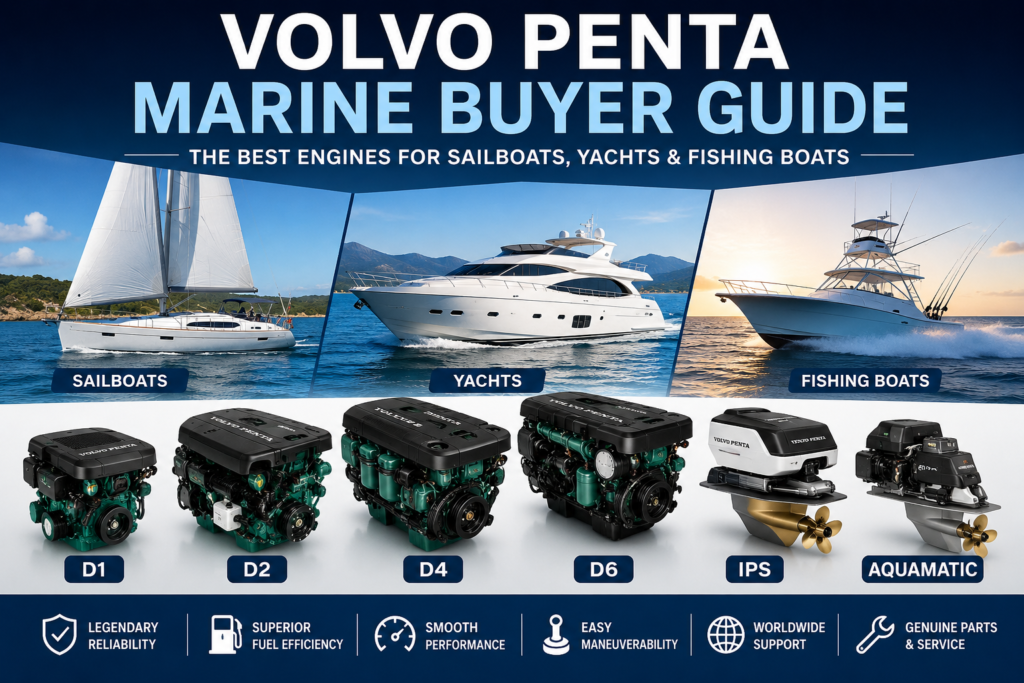
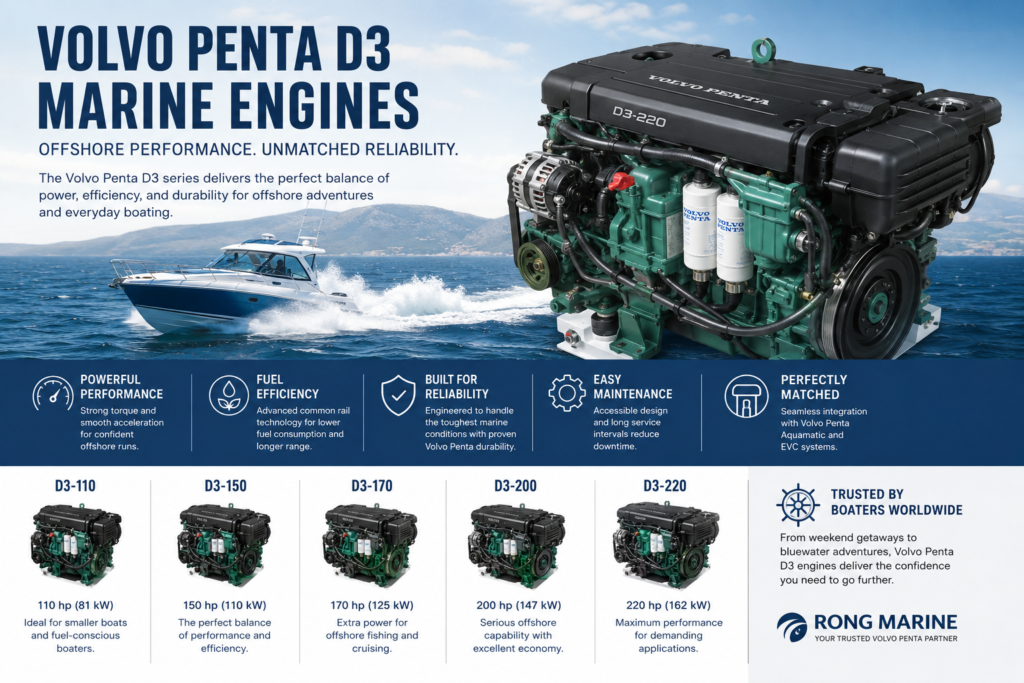
Volvo Penta D3 Marine Engines
The Volvo Penta D3 Marine Engines pair exceptionally well with Aquamatic systems for:
- Family cruisers
- Sport boats
- Coastal cruising
- Light offshore applications
Owners appreciate the combination of diesel efficiency with responsive sterndrive handling.
Volvo Penta D4 Marine Engines
Many buyers consider the combination of Volvo Penta D4 Marine Engines and Aquamatic drives to be an ideal balance of performance and economy.
This package is commonly found in:
- Express cruisers
- Offshore fishing boats
- Mid-size luxury cruisers
The D4 provides excellent torque while the sterndrive enhances maneuverability and cruising efficiency.
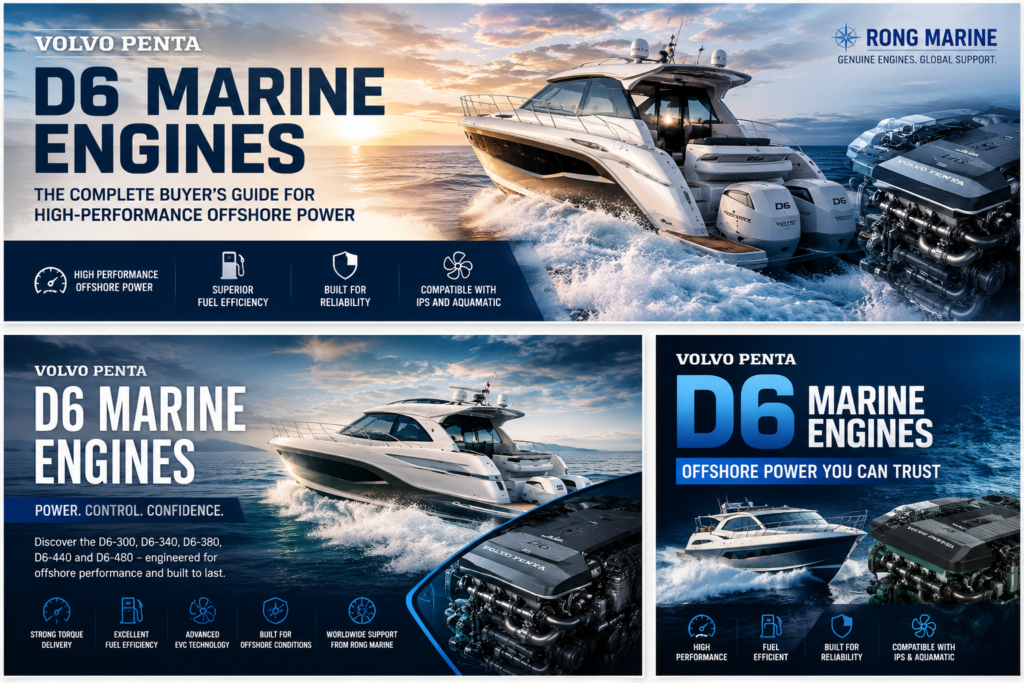
Volvo Penta D6 Marine Engines
The Volvo Penta D6 Marine Engines represent one of the most powerful Aquamatic pairings available.
They are frequently selected for:
- Larger offshore cruisers
- High-performance boats
- Premium recreational vessels
For operators seeking offshore capability without moving into pod-drive technology, this combination remains extremely popular.
Volvo Penta V6 and V8 Gasoline Engines
Aquamatic systems are also widely paired with Volvo Penta gasoline engines.
These installations are common in:
- Bowriders
- Family sport boats
- Day cruisers
- Watersports boats
Gasoline-powered Aquamatic packages offer strong acceleration and responsive handling for recreational boating.
Why Boat Owners Continue Choosing Aquamatic
One thing we’ve learned after working with boat owners for many years is that purchasing decisions are rarely based on technical specifications alone.
People remember experiences.
One customer upgraded from a traditional inboard shaft-drive cruiser to an Aquamatic-powered express cruiser.
Several months later, we asked what he liked most.
We expected him to mention speed.
Instead, he replied:
“I use my boat more often now because it’s simply easier to handle.”
That answer says a great deal.
A propulsion system should encourage owners to spend more time enjoying their boat—not worrying about operating it.
Easier Trailering
For owners who transport their boats between locations, Aquamatic provides another practical advantage.
Because the drive can be trimmed upward, it becomes easier to:
- Launch
- Recover
- Transport
- Navigate shallow ramps
This flexibility makes Aquamatic especially attractive for trailerable recreational boats.
Better Operation in Shallow Water
Another frequently overlooked advantage is shallow-water capability.
By trimming the sterndrive upward, operators can reduce draft when approaching beaches, ramps, or shallow anchorages.
While proper caution is always necessary, this feature provides additional flexibility compared with many fixed-shaft installations.
Improved Docking Confidence
Although Volvo Penta IPS receives significant attention for joystick docking, experienced Aquamatic owners also appreciate the excellent low-speed maneuverability sterndrives provide.
Because the drive itself turns during steering, boats often respond quickly and predictably around docks and marinas.
For recreational boat owners, that responsiveness can significantly reduce docking stress.
Volvo Penta Aquamatic vs IPS
One of the most common questions we receive is:
“Should I choose Volvo Penta Aquamatic or Volvo Penta IPS?”
The honest answer is:
It depends on the boat and how you plan to use it.
Neither system is universally better.
Each excels in different situations.
Why Choose Aquamatic?
Many owners prefer Aquamatic because it offers:
- Excellent performance
- Adjustable trim
- Strong acceleration
- Responsive handling
- Simpler propulsion layout for many recreational applications
- Lower initial investment on many boat types
Why Choose IPS?
Many buyers choose Volvo Penta IPS Marine Propulsion Systems because they prioritize:
- Joystick docking
- Dynamic Positioning System
- Premium cruising comfort
- Outstanding fuel efficiency
- Reduced vibration
- Luxury yacht applications
At Rong Marine, our recommendation always depends on the customer’s vessel, boating habits, and long-term ownership goals—not simply on which technology is newer.
Volvo Penta Aquamatic vs Shaft Drives
Traditional shaft drives continue to be an outstanding propulsion solution for many commercial vessels and larger displacement boats.
However, Aquamatic offers several advantages for recreational applications.
Many owners appreciate:
- Adjustable trim
- Faster acceleration
- Better planing characteristics
- Responsive steering
- Compact propulsion packaging
Meanwhile, shaft drives often remain preferred for:
- Certain commercial operations
- Heavy displacement vessels
- Applications requiring maximum mechanical simplicity
Understanding these differences allows buyers to make informed decisions rather than relying on marketing claims.
Fuel Efficiency and Offshore Performance
Modern Volvo Penta Aquamatic Sterndrive Systems are designed to help boats perform efficiently across a wide range of operating conditions.
Proper trim adjustment allows operators to optimize hull attitude, reduce drag, and improve cruising efficiency.
Many owners notice:
- Faster transition onto plane
- Improved cruising economy
- Better overall handling
- Comfortable offshore operation
These practical improvements contribute to lower operating costs while making long days on the water more enjoyable.
At Rong Marine, we’ve seen many customers discover that the greatest benefit isn’t necessarily maximum speed—it’s how relaxed they feel after several hours at sea.
Maintenance and Long-Term Ownership
One of the biggest myths surrounding Volvo Penta Aquamatic Sterndrive Systems is that they require excessive maintenance compared to other marine propulsion systems.
The reality is much more balanced.
Like any propulsion system operating in a harsh marine environment, Aquamatic drives perform best when they are serviced regularly and inspected by qualified marine technicians.
At Rong Marine, we’ve worked with boat owners whose Aquamatic systems have provided years of dependable service because they followed a simple preventative maintenance routine. We’ve also seen drives suffer unnecessary wear because routine inspections were postponed.
The difference is rarely the drive itself.
It’s almost always the maintenance.
Routine servicing typically includes:
- Engine oil and filter changes
- Gear oil replacement
- Bellows inspection
- U-joint inspection
- Gimbal bearing inspection
- Hydraulic trim system checks
- Steering system inspection
- Propeller inspection
- Anode replacement
- Cooling system maintenance
Following the manufacturer’s recommended service schedule not only protects performance but also helps preserve the long-term value of your boat.
What Experienced Aquamatic Owners Know
One thing experienced boat owners understand is that maintenance is much easier—and far less expensive—than repairing major failures.
One customer who has operated the same Aquamatic-powered cruiser for more than a decade shared something we often repeat to new owners:
“I don’t wait for something to go wrong. I service it before it has the chance.”
That philosophy has served him well.
Preventative maintenance often results in:
- Better marine engine reliability
- Lower ownership costs
- Improved fuel efficiency
- Higher resale value
- Greater offshore confidence
It’s one of the reasons many long-term Aquamatic owners remain loyal to the platform.
Why Genuine Volvo Penta Parts Matter
Another question we frequently receive concerns replacement parts.
Can aftermarket components work?
Sometimes.
However, for critical propulsion components, we generally recommend using genuine Volvo Penta parts.
These components are engineered specifically for:
- Correct fitment
- Material compatibility
- Long-term durability
- Manufacturer performance standards
When you’re operating offshore, reliability matters more than saving a small amount on replacement parts.
Many experienced captains view genuine components as inexpensive insurance against unnecessary downtime.
Common Volvo Penta Aquamatic Myths
Because Aquamatic has been around for decades, there are plenty of misconceptions about sterndrive technology.
Let’s address a few of the most common.
Myth 1: Sterndrives Are Only for Small Boats
This simply isn’t true.
Modern Volvo Penta Aquamatic Sterndrive Systems are widely used on:
- Express cruisers
- Offshore fishing boats
- Sport cruisers
- Luxury recreational vessels
- Performance boats
The right sterndrive depends on the engine package and the boat—not simply its size.
Myth 2: IPS Is Always Better
This is probably the most common misconception we hear.
The truth is that Volvo Penta IPS and Aquamatic serve different purposes.
IPS offers exceptional joystick maneuverability, Dynamic Positioning, and premium yacht features.
Aquamatic provides:
- Outstanding performance
- Adjustable trim
- Strong acceleration
- Excellent value
- Proven reliability
Neither system is universally “better.”
The best propulsion system is the one that matches the vessel and the owner’s boating style.
Myth 3: Sterndrives Are Difficult to Maintain
Properly maintained Aquamatic drives are straightforward to service.
Like any marine equipment, they require scheduled maintenance.
Ignoring service intervals—not the design itself—is what usually leads to costly repairs.
Myth 4: Aquamatic Is Not Suitable for Offshore Use
We regularly work with customers operating Aquamatic-equipped boats offshore.
Express cruisers, performance fishing boats, and coastal recreational vessels continue to demonstrate that sterndrives can perform exceptionally well when matched correctly to the application.
The key is choosing the appropriate engine, drive, and propeller combination.
Aquamatic Repower Projects
One of the fastest-growing areas of our business at Rong Marine is marine engine repower projects.
Many boats still have excellent hulls but aging propulsion systems.
Instead of replacing the entire boat, owners often choose to modernize the propulsion package.
Signs it may be time for a repower include:
- Increasing maintenance costs
- Reduced performance
- Hard starting
- Excessive smoke
- Poor fuel economy
- Limited parts availability
A modern Volvo Penta Aquamatic Sterndrive System can completely transform the way an older boat performs.
What We Evaluate Before Recommending a Repower
Every repower project begins with an evaluation.
Rather than recommending the biggest available engine, we first consider:
- Hull design
- Vessel displacement
- Existing transom condition
- Steering components
- Fuel system
- Cooling system
- Drive ratio
- Intended cruising speed
- Typical operating conditions
This process helps ensure that the final propulsion package delivers balanced performance rather than simply higher horsepower.
One of the biggest mistakes owners make is selecting an engine without considering how it will work with the sterndrive and the boat itself.
The best repower is always a complete propulsion solution.
Is Volvo Penta Aquamatic Right for Every Boat?
The honest answer is:
No.
And that’s exactly why this guide isn’t simply a sales brochure.
Every propulsion system has strengths and limitations.
Aquamatic Is an Excellent Choice For:
- Express cruisers
- Bowriders
- Sport cruisers
- Cabin cruisers
- Performance boats
- Family recreational boats
- Coastal offshore boats
IPS May Be Better For:
- Luxury yachts
- Flybridge boats
- Premium cruising vessels
- Owners prioritizing joystick docking and Dynamic Positioning
Shaft Drives May Be Better For:
- Heavy commercial vessels
- Large displacement boats
- Applications where mechanical simplicity is the highest priority
Our goal at Rong Marine is never to recommend the newest technology simply because it’s new.
Our goal is to recommend the propulsion system that best fits the customer’s boat, budget, and long-term ownership plans.
Frequently Asked Questions
What is Volvo Penta Aquamatic?
Volvo Penta Aquamatic is a sterndrive propulsion system that combines an inboard engine with a steerable and trimmable drive mounted through the transom, delivering responsive handling, strong performance, and efficient cruising.
Are Volvo Penta Aquamatic Sterndrive Systems Reliable?
Yes.
When serviced according to Volvo Penta’s maintenance schedule, Aquamatic drives have earned a strong reputation for durability and marine engine reliability.
Can Aquamatic Be Used Offshore?
Absolutely.
Many express cruisers, offshore fishing boats, and recreational vessels successfully operate with Volvo Penta Aquamatic Sterndrive Systems in coastal and offshore environments.
Which Engines Work With Aquamatic?
Aquamatic systems are commonly paired with:
- Volvo Penta D3 Marine Engines
- Volvo Penta D4 Marine Engines
- Volvo Penta D6 Marine Engines
- Volvo Penta V6 gasoline engines
- Volvo Penta V8 gasoline engines
The correct pairing depends on the boat’s design and intended use.
How Often Should Aquamatic Drives Be Serviced?
Owners should follow Volvo Penta’s recommended maintenance schedule and have the drive inspected annually or at the manufacturer’s specified service intervals.
Can Older Boats Be Repowered With Aquamatic?
Many can.
However, every repower should begin with a professional assessment of the hull, transom, steering system, and propulsion requirements.
What Is the Difference Between SX, DPS, and DPH?
- SX – Single-prop recreational applications
- DPS – Duoprop performance and efficiency
- DPH – Heavy-duty diesel applications
Each drive is designed for different engines and boating requirements.
Why Boat Owners Choose Rong Marine
Buying a propulsion system is one of the most important investments a boat owner will make.
At Rong Marine, we believe our responsibility extends far beyond supplying engines and drives.
We help customers:
- Compare Volvo Penta Aquamatic Sterndrive Systems
- Select compatible Volvo Penta diesel engines
- Plan marine engine repower projects
- Match propulsion systems to specific vessels
- Source genuine Volvo Penta parts
- Arrange worldwide shipping
- Receive ongoing technical guidance
Our recommendations are based on years of working with recreational boat owners, offshore operators, and commercial customers—not simply product catalogues.
That practical experience allows us to provide balanced advice tailored to each customer’s needs.
Final Thoughts
For more than sixty years, Volvo Penta Aquamatic Sterndrive Systems have helped shape modern recreational boating.
Their success isn’t based on marketing.
It’s based on decades of real-world performance.
Boat owners continue choosing Aquamatic because it delivers a combination of:
- Responsive handling
- Strong acceleration
- Excellent Marine propulsion
- Adjustable trim
- Comfortable cruising
- Proven long-term reliability
Like every propulsion system, Aquamatic isn’t the perfect solution for every boat.
But when matched correctly to the right vessel, it offers an outstanding balance of performance, efficiency, and enjoyment.
At Rong Marine, that’s the advice we give every customer.
Not because one propulsion system is universally better than another.
But because the right propulsion system is the one that helps you spend more time enjoying your boat—and less time worrying about it.


Leave a Reply