

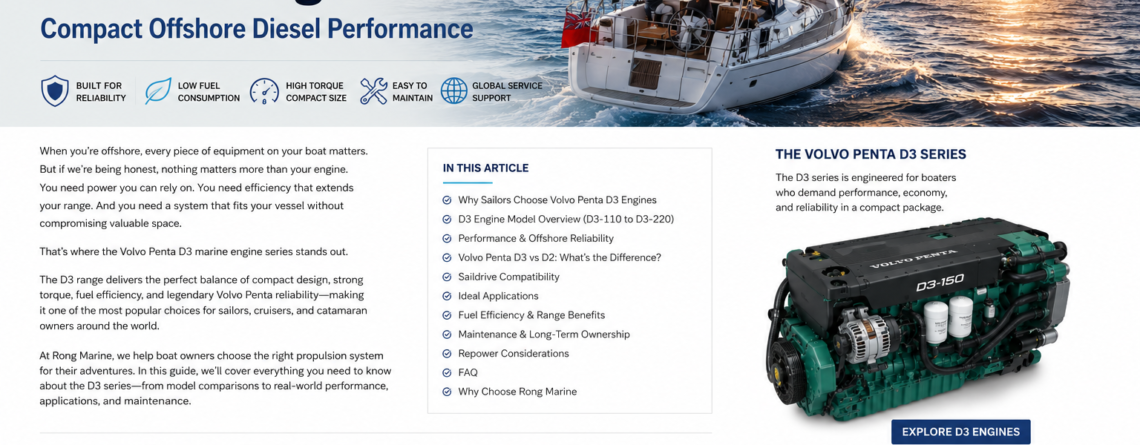
When you’re offshore, everything changes.
At the marina, engine specifications look impressive on paper. Horsepower figures sound exciting. Every manufacturer claims their engine is the most reliable, most efficient, and most advanced option available.
But 50 miles offshore, when the weather suddenly changes, fuel docks are nowhere in sight, and you need dependable power to get your crew home safely, the only question that matters is:
Can you trust your engine?
That question is exactly why so many experienced boat owners continue choosing Volvo Penta D3 Marine Engines.
At Rong Marine, we’ve worked with customers repowering everything from compact coastal cruisers to offshore fishing boats operating hundreds of miles from shore. One thing we’ve consistently observed is that buyers who prioritize reliability, fuel efficiency, and proper propulsion matching are almost always happier long-term than buyers who focus only on horsepower numbers.
The Volvo Penta D3 Marine Engines have become especially popular among owners looking for strong offshore performance without stepping into significantly larger and heavier diesel platforms.
For many boaters, the D3 represents the perfect middle ground between compact design, modern technology, fuel efficiency, and dependable offshore capability.
Whether you’re researching a new propulsion package, comparing marine diesel options, or planning a repower project, this guide will help you understand why the D3 platform remains one of the most respected offshore marine diesel engines on the market today.
In this guide, you’ll learn:
- The differences between each D3 model
- Which D3 engine is right for your boat
- Why offshore captains trust the platform
- Fuel efficiency and cruising range expectations
- Aquamatic compatibility
- Repower considerations
- Long-term ownership insights
- Why so many owners continue choosing Volvo Penta propulsion systems
Why Volvo Penta D3 Marine Engines Are So Popular
The marine engine market is full of options.
Some engines prioritize fuel economy.
Others focus almost entirely on horsepower.
The Volvo Penta Engines for Sale platform sits in a unique position because it successfully combines:
- Offshore performance
- Fuel efficiency
- Compact dimensions
- Modern technology
- Long-term reliability
That combination has made the D3 one of the most popular choices for:
- Offshore fishing boats
- Express cruisers
- Sport cruisers
- Commercial vessels
- Patrol boats
- Workboats
- Performance recreational boats
What many boat owners discover is that the D3 platform delivers the kind of real-world performance that matters most offshore.
Not just speed.
But confidence.
What Boat Owners Notice After Upgrading
One offshore fishing customer recently contacted us after replacing an aging diesel engine with a Volvo Penta D3-200.
Interestingly, his first comment wasn’t about speed.
It wasn’t about fuel consumption either.
Instead, he said:
“The entire boat feels more refined. It’s quieter, smoother, and I have more confidence running offshore.”
That type of feedback is surprisingly common.
Most owners initially focus on horsepower numbers during the buying process.
After spending time on the water, however, they often appreciate entirely different benefits:
- Better throttle response
- Reduced vibration
- Lower noise levels
- Improved fuel efficiency
- Greater offshore confidence
Those ownership experiences are rarely listed on specification sheets, but they are often the reasons owners become loyal Volvo Penta customers.
What Makes the Volvo Penta D3 Different?
One of the biggest surprises for first-time buyers is discovering how much performance Volvo Penta has extracted from such a compact engine platform.
The Volvo Penta D3 marine engine incorporates several advanced technologies, including:
- Common rail fuel injection
- Turbocharging
- Charge-air cooling
- Electronic Vessel Control (EVC)
- Advanced engine management systems
The result is an engine that feels responsive, efficient, and powerful without requiring the size and weight of larger diesel platforms.
Many owners moving from older mechanical diesel engines immediately notice:
- Faster starting
- Smoother operation
- Cleaner combustion
- Improved acceleration
- Better fuel economy
For boaters seeking a modern marine propulsion solution, the D3 platform remains one of the strongest options available.
Understanding the Volvo Penta D3 Marine Engine Series
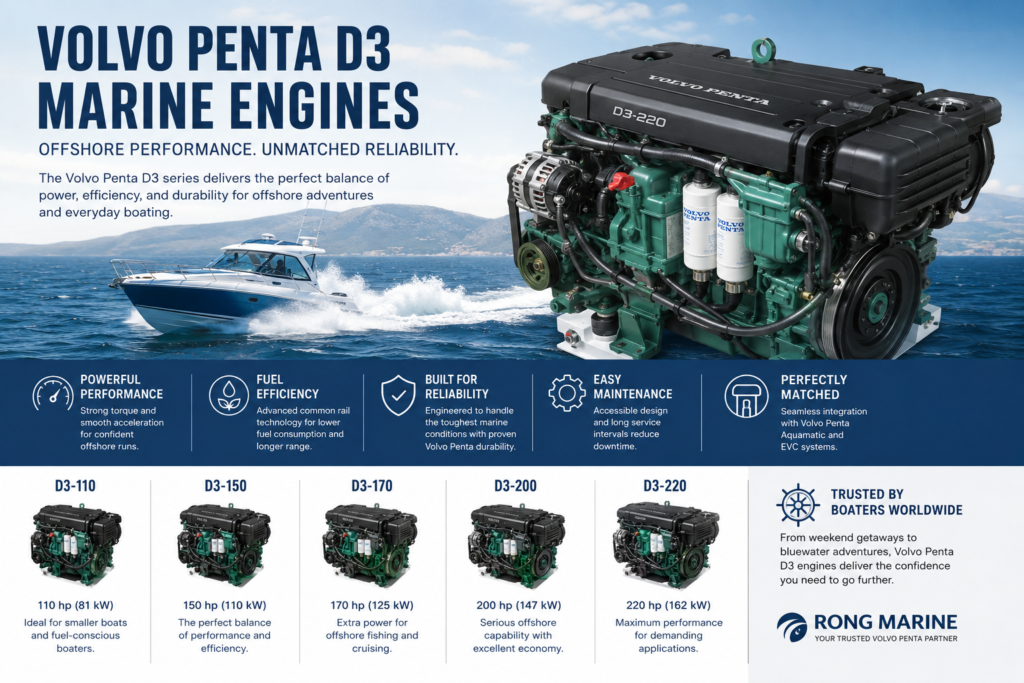
The D3 family includes five primary models:
- Volvo Penta D3-110,
- Volvo Penta D3-150,
- Volvo Penta D3-170,
- Volvo Penta D3-200,
- Volvo Penta D3-220,
While horsepower increases across the range, all D3 engines share several characteristics:
- Compact design
- Lightweight construction
- Modern common-rail technology
- Excellent power-to-weight ratio
- Offshore reliability
- Volvo Penta EVC integration
Choosing the right model depends on:
- Vessel size
- Operating profile
- Desired cruising speed
- Offshore usage
- Load requirements
Let’s look at each model in more detail.
Volvo Penta D3-110 Marine Diesel Engines
The Volvo Penta D3-110 serves as the entry point into the D3 lineup.
It is commonly used in:
- Smaller cruising boats
- Compact commercial vessels
- Coastal recreational boats
- Light-duty offshore applications
Despite being the smallest D3 model, it still benefits from the same advanced engineering found throughout the entire range.
Owners appreciate:
- Excellent fuel economy
- Compact installation footprint
- Low operating costs
- Proven reliability
Who Should Choose the D3-110?
In our experience, the Volvo Penta D3-110 is best suited for owners who prioritize efficiency, simplicity, and dependable operation over maximum performance.
It works particularly well for:
- Coastal cruising
- Recreational boating
- Light commercial operations
- Boats where fuel efficiency is a major priority
For many owners, the D3-110 provides all the power they realistically need while maintaining extremely manageable ownership costs.
Volvo Penta D3-150 Marine Diesel Engines
The Volvo Penta D3-150 is often viewed as one of the most versatile engines in the lineup.
It provides a noticeable increase in horsepower and torque while maintaining the compact dimensions and fuel efficiency that make the D3 platform attractive.
This model is commonly found in:
- Cruising boats
- Sport cruisers
- Recreational offshore vessels
- Coastal fishing boats
Many owners find the D3-150 delivers an ideal balance between:
- Performance
- Efficiency
- Reliability
- Affordability
Why Many Buyers Choose the D3-150
The D3-150 often appeals to boat owners seeking additional offshore capability without dramatically increasing fuel consumption.
Many Rong Marine customers consider it the sweet spot among the lower-powered D3 models because it successfully balances:
- Fuel economy
- Offshore confidence
- Ownership costs
- Everyday usability
For mixed-use boating applications, it remains one of the strongest choices in the D3 family.
Volvo Penta D3-170 Marine Diesel Engines
The Volvo Penta D3-170 begins moving firmly into performance territory.
This model is frequently selected for:
- Offshore fishing boats
- Larger cruisers
- Performance-oriented recreational vessels
- Commercial applications
The additional horsepower provides:
- Stronger acceleration
- Improved load-carrying capability
- Better offshore performance
- Increased cruising flexibility
A Popular Choice for Offshore Fishing
The Volvo Penta D3-170 has become particularly popular among offshore fishermen who regularly travel significant distances from shore.
The additional power provides greater confidence when:
- Running through changing sea conditions
- Carrying extra fuel and gear
- Returning ahead of weather systems
- Operating with multiple passengers onboard
One offshore customer recently told us:
“The D3-170 gave me enough power to comfortably make longer runs without feeling like I was pushing the engine too hard.”
That confidence matters offshore.
And it’s one reason the D3-170 remains such a popular model.
Volvo Penta D3-200 Marine Diesel Engines
The Volvo Penta D3-200 is one of the most sought-after engines in the D3 lineup.
This model offers an outstanding combination of:
- Power
- Torque
- Fuel efficiency
- Offshore capability
It is commonly found in:
- Offshore sportfishing boats
- Express cruisers
- Recreational performance vessels
- Commercial applications
Many owners view the D3-200 as the point where the D3 family begins delivering serious offshore performance while still maintaining the compact characteristics that make the platform attractive.
The D3-200 has become one of the most requested models among customers looking for dependable offshore marine diesel engines that do not require the size and weight of larger propulsion systems. D3-220 disappointing experience with Volvo Penta.
Volvo Penta D3-220 Marine Diesel Engines
At the top of the range sits the Volvo Penta D3-220.
This is the flagship D3 model and delivers the highest output in the lineup.
Owners choose the D3-220 because it provides:
- Maximum horsepower
- Excellent torque delivery
- Strong offshore capability
- Impressive power-to-weight ratio
The D3-220 is especially popular among:
- Offshore fishing boats
- Performance cruisers
- Heavy recreational vessels
- Commercial operators
Why Offshore Operators Often Prefer the D3-220
Many first-time buyers assume the Volvo Penta D3-220 is primarily about speed.
In reality, experienced captains often choose it for an entirely different reason:
Torque.
The additional torque becomes extremely valuable when:
- Carrying heavy loads
- Running long offshore routes
- Operating in rough conditions
- Towing equipment
- Managing changing sea states
For many offshore operators, that added confidence is worth far more than a few additional knots of top speed.
And that is exactly why the D3-220 remains one of the most respected compact offshore diesel engines in the Volvo Penta lineup.
What Makes the D3 Different From the D1 and D2 Series?
One of the most common questions we hear at Rong Marine is:
“Should I choose a D1, D2, or D3?”
The answer depends largely on your vessel and intended application.
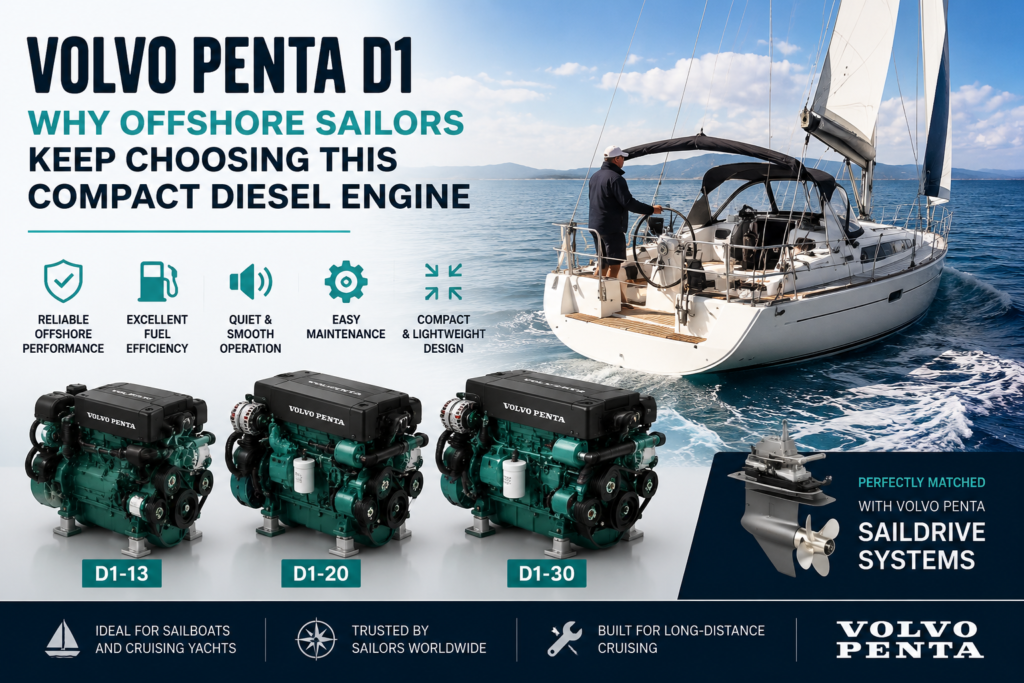
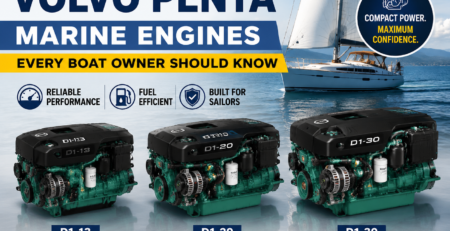
Volvo Penta D1 Marine Engines
Typically designed for:
- Sailboats
- Auxiliary propulsion
- Compact cruising vessels
Volvo Penta D2 Marine Engines
Typically used for:
- Cruising sailboats
- Catamarans
- Offshore sailing applications
Volvo Penta D3 Marine Engines
Primarily designed for:
- Powerboats
- Offshore fishing vessels
- Express cruisers
- Commercial boats
- High-performance marine applications
For owners seeking compact offshore diesel performance, the D3 platform often becomes the natural progression.
Volvo Penta Aquamatic Compatibility
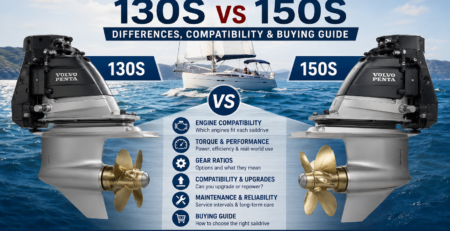
One of the biggest reasons boat owners choose Volvo Penta D3 Marine Engines is the ability to pair them with the highly respected Volvo Penta Aquamatic propulsion system.
For decades, Aquamatic drives have helped define Volvo Penta’s reputation for performance, maneuverability, and fuel efficiency.
Many D3 engines are commonly paired with:
- DPH drives
- DPS drives
- Aquamatic sterndrives
- Electronic Vessel Control (EVC) systems
Together, they create a propulsion package designed to maximize:
- Fuel efficiency
- Acceleration
- Handling
- Offshore performance
- Driver confidence
At Rong Marine, many customers initially focus on the engine itself, but after sea trials, they often realize how much the complete propulsion package contributes to the overall boating experience.
Why Aquamatic Systems Are So Popular
Boat owners frequently report improvements in:
- Hole-shot acceleration
- Mid-range performance
- Fuel economy
- Low-speed maneuverability
- Cruising comfort
Especially when paired with modern D3 engines, Aquamatic systems create a highly refined driving experience.
One customer upgrading from an older shaft-drive setup recently described the difference as:
“It feels like driving a completely different boat.”
That type of feedback is common among owners transitioning to modern Volvo Penta propulsion systems.
What Offshore Captains Value Most
After speaking with offshore operators for years, we’ve noticed something interesting.
Most first-time buyers focus heavily on horsepower.
Experienced captains usually don’t.
Instead, they prioritize:
- Reliability
- Fuel range
- Serviceability
- Torque
- Global parts support
Because when you’re offshore, top speed becomes less important than predictable performance.
The ability to trust your propulsion system often matters far more than gaining a few extra knots.
That is one reason Volvo Penta D3 Marine Engines continue earning strong reputations among:
- Offshore fishermen
- Charter operators
- Commercial captains
- Recreational cruisers
The platform delivers what experienced operators value most:
Confidence.
Offshore Performance and Reliability
Offshore boating exposes weaknesses quickly.
Weather changes.
Sea conditions deteriorate.
Loads increase.
Operating hours accumulate.
And that’s where truly reliable engines separate themselves from average ones.
The Volvo Penta D3 marine engine platform has earned a strong following because it consistently performs in demanding offshore environments.
Owners frequently report:
- Reliable starting
- Smooth operation
- Strong torque delivery
- Low vibration
- Predictable performance
One experienced offshore captain once told us:
“The best engine is the one you never have to think about.”
That’s exactly what many D3 owners describe.
Not excitement.
Not drama.
Simply confidence.
And confidence offshore is incredibly valuable. Volvo Penta D3-200 replacement?
Why Reliability Matters More Than Horsepower
Many buyers initially compare engines based on horsepower ratings.
Experienced operators usually compare engines differently.
They ask:
- Will it start every time?
- How easy is it to maintain?
- Can I find parts globally?
- How does it perform under load?
- How does it behave after thousands of operating hours?
Those are the questions that determine long-term ownership satisfaction.
The D3 platform performs particularly well in these areas.
Fuel Efficiency and Cruising Range
Fuel efficiency remains one of the strongest reasons boat owners choose Volvo Penta D3 Marine Engines.
Fuel costs continue increasing worldwide.
At the same time, many owners want:
- Longer cruising range
- Reduced operating expenses
- Greater offshore flexibility
Modern common-rail diesel technology helps the D3 platform deliver exactly that.
Why Fuel Economy Matters Offshore
A few gallons saved on a short marina trip may not seem significant.
But offshore boating is different.
Long-distance runs often involve:
- Extended cruising hours
- Changing weather conditions
- Additional fuel reserves
- Greater operating costs
Improved fuel efficiency can translate into:
- Longer range
- Fewer fuel stops
- Lower annual operating expenses
- Increased offshore safety margins
Those advantages become substantial over hundreds or thousands of operating hours.
How the D3 Compares to Older Marine Diesels
Many customers upgrading from older diesel platforms immediately notice:
- Reduced fuel consumption
- Cleaner operation
- Lower smoke output
- Smoother throttle response
- Improved overall efficiency
One offshore cruiser recently described the upgrade as:
“The engine felt more modern in every way.”
That observation reflects what many D3 owners experience after moving away from older-generation marine propulsion systems.
Volvo Penta D3 Repower Projects
One of the fastest-growing segments we see at Rong Marine involves marine engine repower projects.
Many vessels currently operating offshore were originally equipped with engines installed 15, 20, or even 30 years ago.
Eventually owners begin experiencing:
- Hard starting
- Excessive smoke
- Increasing maintenance costs
- Fuel consumption concerns
- Reliability issues
- Parts availability challenges
At that point, replacing the engine often becomes more economical than continuing repairs.
Why the D3 Is a Popular Repower Choice
The Volvo Penta D3 Marine Engine offers several advantages for repower projects:
- Compact dimensions
- Modern technology
- Strong power-to-weight ratio
- Excellent fuel efficiency
- Proven offshore reliability
Many customers are surprised by how dramatically a repower can transform their boat.
Benefits often include:
- Improved performance
- Lower operating costs
- Better fuel economy
- Increased resale value
- Greater owner confidence
In many cases, a repower feels like purchasing a newer vessel
A Common Repower Mistake
One of the most common mistakes we encounter during repower consultations is choosing a replacement engine based solely on the horsepower rating of the existing engine.
Successful repower projects require evaluating:
- Vessel displacement
- Hull characteristics
- Drive compatibility
- Intended cruising speed
- Future operating plans
- Weight distribution
A properly matched Volvo Penta D3 marine engine often delivers better real-world performance than simply selecting the largest engine that physically fits inside the engine compartment.
That is why professional propulsion matching remains so important.
Important Repower Considerations
Before beginning any repower project, we encourage owners to evaluate:
Engine Beds
Existing engine foundations may require modifications.
Drive Systems
Compatibility between the engine and drive package is critical.
Controls and Instrumentation
Modern EVC systems often provide significant advantages over older control systems.
Fuel Systems
Older vessels sometimes require updates to maximize performance and reliability.
Long-Term Ownership Goals
The best engine choice should support not only current needs but also future boating plans.
At Rong Marine, helping customers evaluate these factors is a major part of the repower process.
Because a successful repower involves much more than simply replacing an engine.
Maintenance and Long-Term Ownership
One of the reasons Volvo Penta D3 Marine Engines continue attracting loyal owners is that they are designed for long-term use.
After helping customers operate and maintain marine propulsion systems for years, we’ve learned that reliability offshore is rarely accidental.
Reliable engines are usually the result of:
- Proper installation
- Correct propulsion matching
- Consistent maintenance
- Quality components
Fortunately, the D3 platform has developed a strong reputation for manageable ownership and straightforward servicing.
Routine maintenance typically includes:
- Engine oil changes
- Fuel filter replacement
- Cooling system inspections
- Belt inspections
- Anode replacement
- Drive maintenance
- Scheduled diagnostics
None of these tasks are particularly difficult, but they become incredibly important when operating offshore.
What Long-Term Owners Have Learned
Many D3 owners accumulate thousands of operating hours through consistent preventative maintenance.
In our experience, two of the most overlooked maintenance items are:
- Fuel system cleanliness
- Cooling system inspections
Yet these two areas are often responsible for preventing some of the most expensive offshore failures.
One customer who operates a commercial vessel told us:
“I’ve learned that maintenance is much cheaper than breakdowns.”
That simple statement summarizes the mindset of many experienced operators.
Genuine Volvo Penta Parts vs Aftermarket Components
One question we hear regularly is:
“Should I use genuine Volvo Penta parts?”
While quality aftermarket components certainly exist, many owners prefer genuine Volvo Penta Parts because they offer:
- Proven compatibility
- Consistent quality control
- Reliable fitment
- Manufacturer support
When you’re operating offshore, confidence in replacement parts becomes increasingly valuable.
Many experienced captains prefer eliminating unnecessary risks whenever possible.
Volvo Penta D3 vs Cummins vs Yanmar
Eventually many buyers compare:
- Volvo Penta
- Cummins
- Yanmar
All three manufacturers produce respected marine diesel engines.
Each has strengths.
The best solution depends on the vessel and operating profile.
Volvo Penta Advantages
The Volvo Penta D3 Marine Engine platform is particularly strong in:
- Compact design
- Aquamatic integration
- Electronic Vessel Control
- Fuel efficiency
- Power-to-weight ratio
Many recreational and offshore operators appreciate the complete propulsion ecosystem Volvo Penta provides.
Cummins Advantages
Cummins engines are widely respected for:
- Commercial durability
- High-horsepower applications
- Industrial-grade reliability
They are particularly popular in larger commercial and heavy-duty vessels.
Yanmar Advantages
Yanmar remains highly respected for:
- Sailboat applications
- Global parts availability
- Proven diesel technology
- Long-standing marine reputation
Yanmar engines are especially common in sailing vessels and cruising yachts
Which Is Best?
The honest answer is:
It depends.
Factors such as:
- Vessel size
- Cruising speed
- Weight
- Operating environment
- Propulsion system
all influence the correct choice.
That is why professional propulsion matching remains so important.
Is the Volvo Penta D3 Right for Every Boat?
Not necessarily.
While the Volvo Penta D3 Marine Engines are among the best compact offshore diesel platforms available today, every vessel has unique requirements.
Some larger vessels may be better suited to:
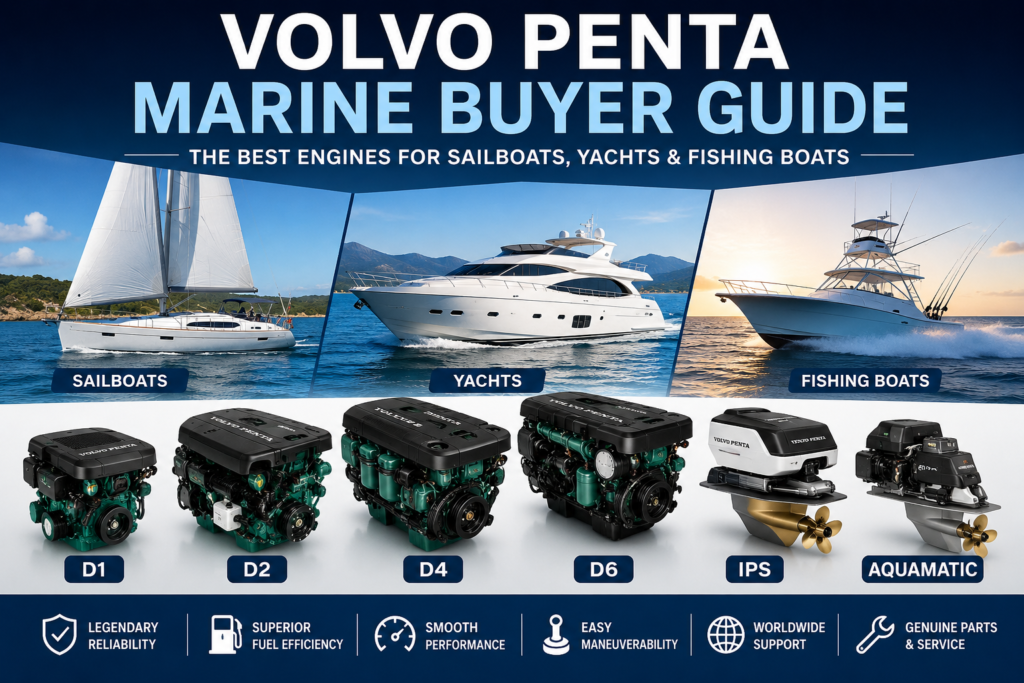
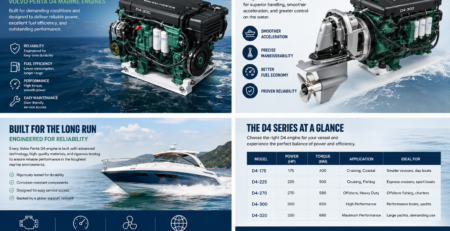
- Volvo Penta D4 Marine Engines
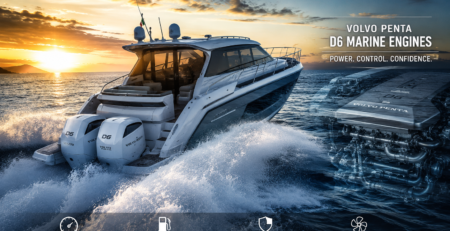
- Volvo Penta D6 Marine Engines
Choosing the right propulsion package depends on:
- Vessel displacement
- Cruising profile
- Load requirements
- Performance expectations
- Intended use
At Rong Marine, we always encourage buyers to focus on the overall propulsion package rather than simply choosing the highest horsepower available.
The correct engine is the one that matches the boat.
Best Applications for Volvo Penta D3 Marine Engines
The D3 platform excels in a wide variety of applications.
Offshore Fishing Boats
The strong torque and excellent fuel economy make the D3 particularly popular among offshore anglers.
Express Cruisers
Owners appreciate the balance between performance and efficiency.
Sport Cruisers
Fast acceleration and responsive handling enhance the overall boating experience.
Commercial Vessels
Reliability and manageable operating costs remain major advantages.
Patrol Boats
Dependable performance under demanding conditions is critical.
Workboats
The D3 platform provides strong long-term durability while maintaining fuel efficiency.
Frequently Asked Questions About Volvo Penta D3 Marine Engines
Are Volvo Penta D3 Engines Reliable?
Yes.
The D3 platform has developed a strong reputation for offshore reliability, fuel efficiency, and long-term durability.
Many owners accumulate thousands of operating hours when maintenance schedules are followed properly.
Which Volvo Penta D3 Model Is Best?
The answer depends on your vessel and operating requirements.
Generally:
- Volvo Penta D3-110 – Economy-focused applications
- Volvo Penta D3-150 – Balanced recreational use
- Volvo Penta D3-170 – Offshore fishing and cruising
- Volvo Penta D3-200 – Serious offshore capability
- Volvo Penta D3-220 – Maximum performance within the D3 lineup
Are D3 Engines Fuel Efficient?
Yes.
One of the biggest reasons owners choose Volvo Penta D3 Marine Engines is the combination of strong performance and efficient fuel consumption.
Are D3 Engines Good for Repower Projects?
Absolutely.
The D3 platform remains one of the most popular choices for Marine Engine Repower Guide projects because it offers:
- Modern technology
- Improved reliability
- Better fuel economy
- Strong resale value
How Long Do Volvo Penta D3 Engines Last?
Engine lifespan depends heavily on:
- Maintenance
- Operating conditions
- Installation quality
- Usage patterns
Properly maintained D3 engines can deliver many years of dependable service.
What Drives Work With Volvo Penta D3 Engines?
Many D3 engines are paired with:
- Volvo Penta Aquamatic
- DPS drives
- DPH drives
The correct configuration depends on the vessel and application.
Why Boat Owners Choose Rong Marine
At Rong Marine, we understand that purchasing a marine engine is not simply about buying horsepower.
It is about finding the right propulsion system for your boat, your operating profile, and your long-term goals.
We assist customers worldwide with:
- Engine selection
- Propulsion matching
- Aquamatic compatibility
- Repower consultations
- Export logistics
- Technical guidance
Many of our customers are investing in equipment they expect to use for years.
That makes choosing the right solution especially important.
Why Professional Propulsion Advice Matters
One thing we’ve consistently learned is that every boat is different.
Two vessels may have similar dimensions but require completely different propulsion solutions.
Factors such as:
- Weight
- Hull design
- Intended cruising speed
- Passenger loads
- Offshore requirements
all influence the best engine choice.
That is why experienced guidance often saves owners significant time, money, and frustrationRequest a Quote for Volvo Penta D3 Marine Engines
If you’re researching genuine Volvo Penta D3 Marine Engines, comparing:
- Volvo Penta D3-110
- Volvo Penta D3-150
- Volvo Penta D3-170
- Volvo Penta D3-200
- Volvo Penta D3-220
or evaluating options for a future repower project, Rong Marine can help.
Our team provides assistance with:
- Propulsion recommendations
- Aquamatic matching
- Offshore performance planning
- Repower consultations
- Worldwide shipping support
For many offshore operators, the D3 platform represents the ideal combination of:
- Compact size
- Modern technology
- Fuel efficiency
- Offshore reliability
- Long-term value
And that is exactly why so many boat owners continue choosing Volvo Penta D3 Marine Engines year after year.

Comment (1)
[…] Volvo Penta D3 Marine Engines […]