Prepared by: Rong Marine Engine Supply Team Fact-checked: August 2, 2026 Technical basis: Official Yanmar product pages, operation manuals, service guidance, parts information and warranty resources
When a Yanmar engine needs maintenance, troubleshooting or replacement parts, many owners begin with a simple Google search: “Yanmar engine manual PDF.”
That sounds straightforward—until the search results produce five different manuals for engines with almost identical model names.
One manual may cover a mechanical engine. Another may be for a later common-rail version. A third may cover the correct engine family but the wrong marine gearbox, control panel or saildrive. The documents can look convincing while still being wrong for the actual installation.
That is why finding the correct Yanmar marine engine manual should begin with the engine identification plate—not the colour of the engine, the boat model or a partial model name remembered by the previous owner.
The right manual helps you understand safe operation, maintenance intervals, fluid specifications, alarm codes, service procedures and replacement parts. The wrong one can lead to incorrect oil, wrong filters, unsuitable tightening values, improper bleeding procedures or incompatible parts.
This guide explains how to locate and verify the correct owner, operation, service, workshop and parts manual for Yanmar marine diesel engines. It also covers gearboxes, saildrives, control systems, discontinued engines and the information a supplier needs when helping you identify a manual or replacement part.
Important safety notice: This article provides general document-identification guidance. It does not replace the official manual for your exact engine and propulsion system. Repairs involving internal engine components, common-rail fuel systems, electrical controls, lifting, alignment or safety-critical systems should be completed by appropriately qualified technicians. Never loosen high-pressure common-rail fuel pipes while diagnosing an engine.
The correct document depends on what you are trying to do.
Your objective
Manual or document required
What it normally contains
What it does not replace
Learn normal engine operation
Operation or owner’s manual
Controls, starting, stopping, alarms, daily inspections and safety
Workshop-level repair procedures
Perform scheduled maintenance
Operation and maintenance manual
Service intervals, approved fluids, filters and inspection schedules
Model-specific technical training
Diagnose or repair the engine
Service or workshop manual
Testing, adjustment, disassembly, reassembly and specifications
Technician experience and special tools
Identify replacement components
Parts catalog or parts list
Exploded diagrams, reference numbers and component descriptions
Confirmation of superseded part numbers
Install or repower an engine
Installation manual and drawings
Mounting, exhaust, cooling, fuel, electrical and clearance requirements
Vessel-specific engineering approval
Service the transmission
Gearbox operation or service manual
Lubricant, shifting, adjustment, maintenance and repair guidance
The engine manual
Service a saildrive
Saildrive operation or workshop manual
Lubrication, seals, diaphragm, corrosion protection and servicing
The engine or gearbox manual
Understand the instrument panel
Panel or control-system manual
Displays, alarms, controls, wiring and fault information
The complete engine workshop manual
Check warranty requirements
Warranty handbook
Registration, coverage, owner responsibilities and exclusions
The operation and service manuals
In many cases, you need more than one document. A complete vessel library may include separate manuals for the engine, marine gear, saildrive, control panel, fuel-water separator, battery charger and other installed systems.
Why the Correct Yanmar Manual Matters
A manual is only useful when it applies to the exact engine in front of you.
Yanmar has produced mechanical and electronically controlled engines across numerous generations. Small differences in letters, suffixes, production versions and regional specifications can change:
Fuel-system design
Cooling-system arrangement
Oil and coolant requirements
Filter references
Alternator specifications
Control-panel configuration
Alarm and diagnostic procedures
Gearbox compatibility
Service intervals
Tightening specifications
Replacement part numbers
Emissions components
Bleeding procedures
For example, the Yanmar 3YM20 and Yanmar 4JH57 are both compact marine diesel engines, but they belong to different families and use different fuel and control technologies. Their manuals are not interchangeable.
Yanmar’s official 3YM20 product page links to the YM Series operation manual, while the official 4JH57 product page links to a JH common-rail operation manual covering designated 3JH40 and 4JH models.
This family-style publication method is normal. One manual may legitimately cover several closely related engines. However, every model listed on the manual cover must be compared with the complete model shown on your engine plate.
Identify Your Exact Yanmar Engine First
Before downloading anything, locate the engine identification plate and record the information exactly as it appears.
You normally need:
Complete engine model
Engine serial number
Rated output
Rated engine speed
Production or specification suffix, if shown
Approximate year of manufacture
Vessel identification
Gearbox or saildrive model
Gear ratio
Control-panel model
Engine hours
Market or country where the engine was supplied
Do not shorten the model unnecessarily. “Yanmar 4JH” is not enough when several generations and configurations use the JH designation.
Yanmar advises owners to provide both the model and serial number when requesting assistance. Its official Yanmar Marine FAQ explains that the serial number is located on the engine information plate and should be accompanied by the engine model.
Why the Serial Number Is So Important
Two engines carrying similar model names may have production changes that affect individual components. Parts may also be replaced, superseded or supplied as updated assemblies over time.
The Yanmar engine serial number allows a knowledgeable parts supplier or dealer to narrow the search to the correct specification and production range.
A parts number copied from an old online diagram can be a useful starting point, but it should not automatically be treated as the final orderable number. The serial number helps confirm whether that component applies to your engine and whether Yanmar has replaced it with a newer reference.
If the Identification Plate Is Missing or Unreadable
Do not select a manual based only on the engine’s appearance.
Collect clear photographs of:
Complete engine from several angles
Remaining identification labels
Injection system
Exhaust side
Front pulley and belt arrangement
Heat exchanger
Instrument panel
Gearbox or saildrive
Any visible casting or component numbers
Existing maintenance records
Previous invoices or parts packaging
A boat builder, previous owner, servicing dealer or engine supplier may also have retained commissioning or warranty records.
The Main Types of Yanmar Marine Engine Manuals
People often use “owner’s manual,” “repair manual” and “service manual” as if they mean the same document. They do not.
Understanding the difference can save hours of searching.
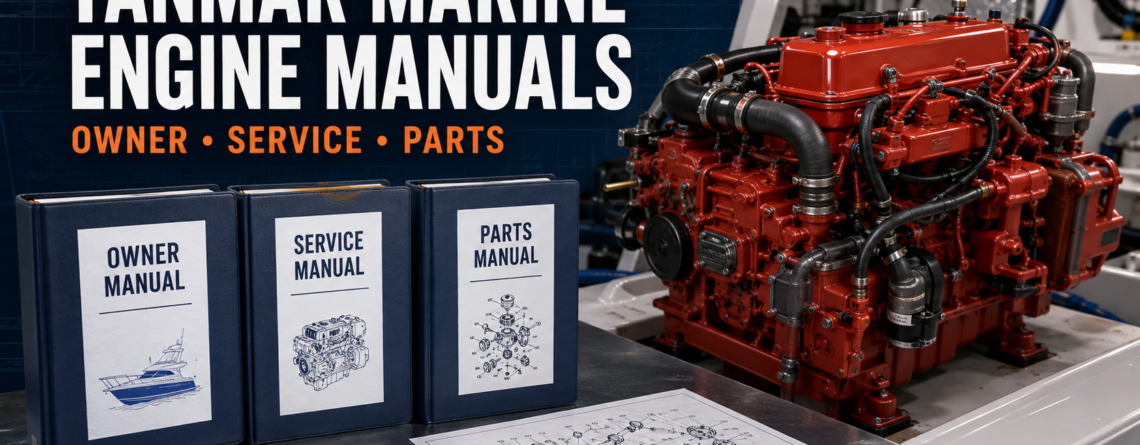
1. Yanmar Operation or Owner’s Manual
What boat owners frequently call a Yanmar owner’s manual is normally titled an “Operation Manual” by Yanmar.
This is the primary document for normal ownership and onboard use. Depending on the engine, it may include:
Safety precautions
Component identification
Instrument-panel information
Before-start checks
Starting and stopping procedures
Break-in guidance
Alarm indicators
Emergency procedures
Daily inspections
Periodic maintenance schedules
Fuel, oil and coolant specifications
Filter and belt inspections
Winterization or seasonal storage
Basic troubleshooting
Technical specifications
Emissions or conformity information
The Yanmar operation manual should be the first manual every owner obtains and reads.
It is also the most appropriate document to keep aboard the vessel. A printed copy remains useful when a phone, tablet or onboard internet connection is unavailable.
However, an operation manual is not necessarily a complete Yanmar repair manual. It may explain owner-level maintenance without providing internal engine tolerances, complete wiring diagnosis or detailed disassembly procedures.
2. Yanmar Service or Workshop Manual
A Yanmar service manual—sometimes called a workshop, shop or repair manual—is intended for deeper technical work.
Depending on the engine family, it may contain:
System descriptions
Diagnostic procedures
Inspection limits
Testing methods
Adjustment procedures
Disassembly sequences
Reassembly sequences
Tightening values
Clearance measurements
Special-tool requirements
Electrical testing
Fuel-system service
Cooling-system service
Cylinder-head work
Internal engine inspection
Troubleshooting charts
A genuine Yanmar workshop manual can be invaluable to a trained technician. But possession of the manual does not automatically make a repair safe or practical.
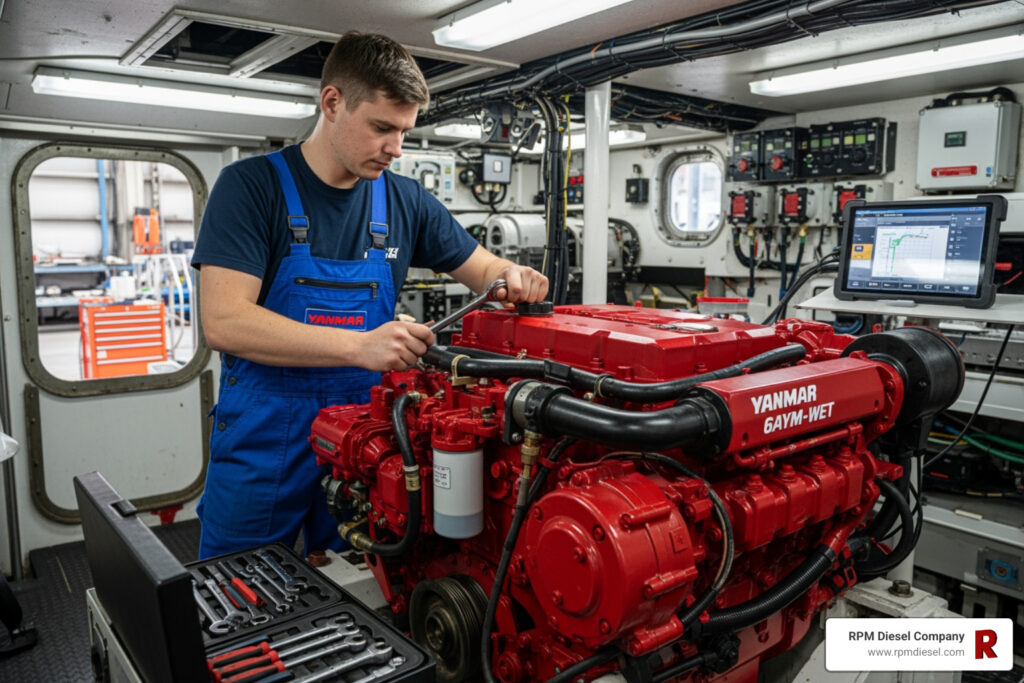
Electronically controlled common-rail engines may require proprietary diagnostic equipment, approved procedures and specialist training. Yanmar’s current service guidance recommends using an authorized dealer for engine service and notes that special equipment is required for certain electronically controlled engines. See the official Yanmar service FAQ for the manufacturer’s current position.
Do not assume every workshop manual is publicly available as a free PDF. Availability varies by model, age, region and document type. For the correct technical literature, contact an authorized Yanmar dealer or regional distributor through the official Yanmar dealer locator.
3. Yanmar Parts Manual or Parts Catalog
A Yanmar parts manual is primarily an identification document.
It normally contains:
Exploded component diagrams
Diagram reference numbers
Part descriptions
Quantities
Assembly groupings
Model or production applicability
Original part references
A Yanmar marine parts catalog helps identify how components fit into assemblies and gives the supplier a useful reference when preparing a quotation.
However, it is important to understand what the catalog does not do.
An exploded drawing is not a repair procedure. It may not show:
The correct removal sequence
Tightening values
Required sealants
One-time-use fasteners
Measurement limits
Special tools
Updated parts
Service bulletins
Superseded numbers
Installation precautions
Yanmar’s official FAQ directs customers seeking a full parts list or parts information to their local dealer or distributor. Its genuine-parts guidance also explains the manufacturer’s quality-control position regarding genuine replacement components.
When ordering parts, use the catalog as supporting evidence—but confirm the part against the complete model and serial number.
4. Yanmar Installation Manual
An installation manual is intended for shipyards, repower specialists, installers and marine technicians.
It may cover:
Engine mounting
Permitted installation angles
Engine-room ventilation
Fuel supply and return
Raw-water intake
Freshwater cooling connections
Exhaust layout
Back-pressure limitations
Electrical connections
Battery cables
Control systems
Lifting points
Service clearances
Alignment
Remote tanks and accessories
An installation manual is especially important during a repower. Matching horsepower alone does not prove that a new engine will work with the vessel’s mounts, exhaust, cooling, shaft, gear ratio or propeller.
If you are comparing replacement options, Rong Marine’s Yanmar marine engine buyer’s guide explains the broader factors involved in choosing a suitable engine family and propulsion package.
5. Yanmar Gearbox Manual
The engine manual may name compatible transmissions, but the marine gear often has its own operation, maintenance or workshop manual.
A Yanmar gearbox manual may include:
Gear identification
Reduction ratio
Lubricant specification
Fluid-level procedure
Shift-linkage adjustment
Operating temperature
Maintenance schedule
Trolling-valve guidance where applicable
Troubleshooting
Disassembly and repair information
Record the complete gearbox model and ratio from its own identification plate. Do not assume the transmission is original simply because the engine is original.
Owners researching replacement transmissions can review Rong Marine’s Yanmar marine gearboxes before requesting compatibility assistance.
6. Yanmar Saildrive Manual
A saildrive is a separate propulsion component with its own maintenance requirements.
A Yanmar saildrive manual may address:
Correct lubricant
Oil-level inspection
Water contamination
Anode replacement
Propeller installation
Seals
Diaphragm inspection or replacement
Corrosion protection
Shift adjustment
Storage
Service procedures
The engine’s operation manual should not be used as a substitute for the drive manual.
If your vessel uses an SD-series drive, identify the complete model and review the available Yanmar saildrives separately from the engine.
7. Control-Panel and Electronic-System Manuals
Modern installations may include a separate manual for the instrument panel, display, vessel-control system or joystick.
This document may explain:
Starting and shutdown controls
Alarm symbols
Display menus
Brightness and configuration
Diagnostic trouble codes
Calibration
Multiple-station operation
Network connections
Emergency operation
A fault code shown on the panel should be recorded before power is disconnected or codes are cleared. Some codes may be described in the engine operation manual, while others require dealer diagnostic equipment.
8. Warranty Handbook and Registration Documents
The warranty handbook is not a repair manual, but it belongs in the same document library.
For example, the official Yanmar 6LY400 product page is the appropriate starting point for owners researching documentation for that modern common-rail model. Rong Marine also lists the Yanmar 6LY400 marine engine for customers comparing specifications, availability and propulsion-package options.
Step 5: Check the Manual’s Cover and Applicability List
Before using the document, verify:
Exact models listed
Engine family
Manual title
Publication or document number
Edition or revision date
Language
Market designation
Gear or drive references
Safety notices
A manual covering several models is acceptable only when your complete model is included.
Do not assume that a newer manual applies to an older engine simply because both engines share the same first letters.
Step 6: Compare the Manual With the Engine
Before following any maintenance instruction, compare visible systems with the illustrations and descriptions in the manual.
Look at:
Fuel-injection layout
Filter positions
Belt arrangement
Heat exchanger
Coolant tank
Control panel
Gearbox
Electrical connectors
Dipsticks and filler points
If the document and engine disagree, stop and investigate. The engine may have been modified, the document may be wrong, or the installed component may differ from the original configuration.
Step 7: Check the Manual Revision
Older copies may remain online after a revised publication becomes available.
Where possible, use the latest applicable edition from an official source. Keep previous versions only when you know they apply to the engine’s production period.
The newest manual is not automatically the correct manual for every older engine. Model applicability remains more important than publication date alone.
Step 8: Contact a Dealer or Knowledgeable Supplier When Uncertain
Yanmar advises owners of discontinued engines to contact a local dealer or regional distributor for operation manuals.
When asking for help, provide:
Complete engine model
Serial number
Photographs of the plate
Gearbox or saildrive model
Required manual type
Preferred language
Description of the planned work
Delivery location if ordering parts
This is much more effective than asking for “the manual for my Yanmar diesel.”
Current Versus Discontinued Yanmar Engines
Finding documentation for a current engine is normally easier because the official product page may still be active and may contain downloadable operation manuals and drawings.
Legacy engines can require more detective work.
Older Yanmar families may include:
GM Series
HM Series
QM Series
Earlier JH generations
Earlier LY engines
Older saildrives
Discontinued gearboxes
Region-specific configurations
A scanned manual for a legacy engine can still be useful, but its source, completeness and revision should be checked carefully.
According to Yanmar’s official FAQ, owners seeking an operation manual for a non-current engine should contact a local dealer or regional distributor. This is also the safer route when the model suffix or production version is unclear.
Rong Marine maintains several legacy and current engine families within its Yanmar diesel engine inventory, which can help owners compare replacement models and identify the broader family to which an engine belongs.
Examples of Model Names That Should Not Be Treated as Interchangeable
Engine stated by owner
Why more information is needed
“Yanmar 3GM”
The complete model and cooling configuration may affect documentation and parts
“Yanmar 4JH”
Several generations, outputs and fuel-system designs use the JH designation
“Yanmar 6LY”
Mechanical and common-rail generations require different procedures
“Yanmar 30 HP”
Horsepower alone does not identify the model
“Yanmar with saildrive”
Both the engine and saildrive models must be identified
“Yanmar KM gearbox”
The complete gearbox model and ratio are required
“Yanmar engine from a 2005 yacht”
Boat year does not reliably prove engine model or production year
The lesson is simple: partial names create expensive mistakes.
Why You Should Be Careful With Unofficial Manual Websites
Third-party manual archives can be useful when official documentation for a discontinued model is difficult to locate. However, they should be treated cautiously.
Potential problems include:
Incomplete scans
Missing safety pages
Incorrect titles
Wrong engine-family labels
Broken diagrams
Unsearchable text
Missing revision information
Altered documents
Unauthorized copyrighted copies
Aggressive advertisements or unsafe downloads
Manuals uploaded for industrial rather than marine engines
Parts books presented as workshop manuals
Before relying on an unofficial Yanmar marine engine manual PDF, compare it with official model information or ask a knowledgeable dealer to verify the document.
Never assume a file is correct simply because the model name appears in its filename. Filenames can be created or changed by anyone.
How to Use a Yanmar Manual Safely
Finding the manual is only the first step. You must also understand its limits.
Read the Safety Section First
Safety warnings explain hazards involving:
High-pressure fuel
Hot coolant
Moving belts and pulleys
Exhaust gases
Battery current
Rotating shafts
Lifting
Fire
Accidental starting
Hazardous fluids
Do not skip these sections to reach the repair procedure faster.
Follow the Correct Maintenance Schedule
Use the Yanmar maintenance schedule for the exact engine rather than a generic online checklist.
Maintenance requirements may depend on:
Operating hours
Calendar time
Recreational or commercial use
Fuel quality
Climate
Storage periods
Dust, salt and humidity
Engine loading
Installed accessories
Record every completed service with the date, engine hours, fluids, filters and parts used.
Treat Fluid Specifications as Model-Specific
Oil, coolant and marine-gear lubricant recommendations can differ between models and installations.
Do not select a fluid only because it was used in another Yanmar engine. Follow the applicable manual and current manufacturer guidance.
Do Not Substitute a Parts Diagram for a Repair Procedure
An exploded diagram shows relationships between parts. It does not necessarily show the safe or correct order of removal and installation.
For internal repairs, use the applicable workshop procedure and obtain professional assistance when required.
Confirm Parts Before Ordering
Before purchasing a replacement part, compare:
Engine model
Serial number
Parts-catalog reference
Physical component
Electrical voltage
Dimensions
Connection type
Production range
Supersession status
This is especially important for injectors, starters, alternators, control components, cooling parts, gear components and electronic modules.
Using Manuals for Troubleshooting
The operation manual is often the first troubleshooting resource aboard the vessel.
It may explain:
Alarm meanings
Starting problems
Overheating
Charging faults
Low oil pressure
Water in the fuel
Basic diagnostic codes
Emergency operation
Shutdown procedures
However, a troubleshooting chart identifies possible causes—not a guaranteed diagnosis.
For persistent overheating, internal engine noise, low oil pressure, common-rail faults or repeated alarms, professional marine engine services may be necessary.
Grinding, slipping, delayed engagement or contaminated transmission lubricant may instead require dedicated transmission and gear services.
Using Manuals to Order Yanmar Parts
A clear parts request reduces delays and prevents avoidable errors.
Provide the supplier with:
Full engine model
Engine serial number
Gearbox or saildrive model
Gear ratio
Photograph of the identification plate
Photograph of the required component
Part number, if known
Parts-diagram figure and item number
Required quantity
Vessel use
Delivery country and postal code
Required timeline
Do not send only a cropped photograph of the broken component. Many filters, pumps, seals and electrical parts look similar across different models.
If you are requesting an overhaul list, explain the scope of work. For example:
Top-end overhaul
Complete engine rebuild
Cooling-system service
Two-year onboard spares package
Fuel-system repair
Gearbox rebuild
Saildrive service
Repower installation
This allows the supplier to identify supporting gaskets, seals and consumables that might otherwise be missed.
Build a Complete Digital and Printed Manual Library
A good vessel document library should be organized before a breakdown occurs.
Create folders for:
Engine
Gearbox
Saildrive or sterndrive
Controls and panels
Electrical system
Fuel system
Steering
Generator
Warranty documents
Service invoices
Parts orders
Technical drawings
Use filenames that remain understandable offline, such as:
Also keep the most important emergency and maintenance pages printed aboard.
A downloaded manual is not useful if it is stored on a laptop left ashore.
Common Mistakes When Searching for Yanmar Manuals
Avoid these frequent errors:
Searching by horsepower instead of model
Using only the engine-family name
Ignoring the serial number
Downloading an industrial-engine manual
Assuming all JH or LY engines are identical
Using an engine manual for the gearbox
Forgetting the saildrive manual
Ordering directly from an old parts number
Using the newest manual without checking applicability
Trusting an unofficial filename
Using a parts catalog as a repair guide
Following a workshop procedure without the required tools
Ignoring regional or production differences
Clearing an electronic fault code before recording it
Keeping the only manual on a device without offline access
The most expensive manual mistake is not failing to find a document. It is confidently using the wrong one.
How Rong Marine Can Help
Rong Marine assists vessel owners, yacht managers, marine technicians, shipyards and commercial operators with sourcing Yanmar engines, compatible propulsion components and service parts.
Our commercial support may include reviewing:
Engine model and serial-number information
Replacement engine options
Parts requirements
Gearbox compatibility
Saildrive compatibility
Gear ratios
Technical drawings
Propulsion-package requirements
Repower information
International shipping requirements
Rong Marine does not replace the official Yanmar operation or workshop manual, and safety-critical repairs should be completed by qualified technicians. Our role is to help customers identify suitable engines, parts and propulsion components and prepare an appropriate quotation.
Need assistance identifying an engine, sourcing parts or selecting a replacement? Contact Rong Marine with the engine model, serial number, photographs, required components and delivery destination.
Frequently Asked Questions
For more information about engine selection, maintenance, ordering, warranties and delivery, visit Rong Marine’s marine diesel engine FAQs.
Where can I download a Yanmar marine engine manual?
For currently offered recreational and light-duty engines, begin with the engine’s official Yanmar product page. Yanmar places applicable operation-manual downloads under individual current model pages. Use the official engine search to locate your model.
Are Yanmar owner’s manuals free?
Many operation manuals for current engines can be downloaded without charge from official Yanmar product pages. Service manuals, workshop manuals and complete parts information may have different availability.
Is an owner’s manual the same as an operation manual?
In normal searches, the terms are often used interchangeably. Yanmar commonly titles the primary owner document “Operation Manual.” Check the title page and contents rather than relying only on the filename.
Is a service manual the same as a parts manual?
No. A service manual explains inspection, diagnosis and repair procedures. A parts manual identifies components through diagrams, descriptions and part references.
How do I find a Yanmar manual for an older engine?
Record the exact model and serial number, then contact an authorized Yanmar dealer or regional distributor. Older manuals may not be available through current product pages.
Can one manual cover several Yanmar engine models?
Yes. Yanmar may publish one operation manual for a related engine family. Your exact model must appear in the manual’s applicability list.
Do I need a separate manual for my Yanmar gearbox?
Usually, yes. The gearbox has its own identification, lubricant, maintenance procedures and service information.
Does a Yanmar saildrive have a separate manual?
Yes. Saildrives have drive-specific requirements involving lubricant, anodes, seals, corrosion protection, propellers and scheduled servicing.
Can I identify parts using only the parts catalog?
A catalog is useful, but the final selection should be checked against the complete engine model, serial number and current supersession information.
What if my manual shows a different component from the one on my engine?
Stop before proceeding. Verify the engine model, manual revision and production applicability. The engine may have been modified, or you may have the wrong manual.
Can I use a Yanmar industrial-engine manual for a marine engine?
Not unless the document specifically includes your marine engine model and application. Marine engines can have different cooling, exhaust, electrical, fuel and installation systems.
Where can I find Yanmar alarm codes?
Some alarm and diagnostic information appears in the applicable operation manual. Electronically controlled engines may require dealer diagnostic software for complete testing.
Should I keep a printed manual aboard?
Yes. A printed operation manual and emergency-reference pages remain accessible when batteries, devices or internet connections fail.
What information should I provide when requesting a parts manual?
Provide the complete engine model, serial number, gearbox or saildrive details, preferred language and photographs of all identification plates.
Final Thoughts
Finding the correct Yanmar marine engine manual is not about locating the first downloadable PDF with “Yanmar” in the title.
It is about matching the document to:
The complete engine model
Serial number
Production version
Gearbox or saildrive
Control system
Required task
Correct publication type
Begin with the identification plate. Decide whether you need an operation, service, parts, installation, gearbox, saildrive or control-system manual. Use official Yanmar product pages whenever possible, and ask a dealer or knowledgeable supplier for help when documentation for a discontinued engine is unclear.
Most importantly, know the limits of the document. An operation manual is not a workshop manual. A parts diagram is not a repair procedure. A manual for a similar engine is not automatically safe for yours.
For assistance sourcing a Yanmar marine engine for sale, compatible gearbox, saildrive, service parts or a complete repower package, contact Rong Marine with your engine, vessel and delivery information.
Sources and Editorial Disclosure
This independent educational article was fact-checked using official Yanmar resources, including:
Yanmar is a trademark of its respective owner. This article does not replace an official Yanmar operation, installation, service or workshop manual. Rong Marine should not be described as an authorized Yanmar dealer unless that status can be documented.


Leave a Reply