

Prepared for Rong Marine
Perspective: Volvo Penta marine engine dealer and propulsion supplier
Technical scope: Volvo Penta common rail marine Diesel engines, controls, maintenance, diagnostics, and repower considerations
Important: Specifications, compatible controls, service intervals, and available features can vary by engine generation, market, configuration, and serial number. Always confirm the exact engine specification before ordering parts or planning an installation.
Most boat owners begin comparing marine engines with three familiar numbers:
- Horsepower
- Displacement
- Fuel consumption
Those numbers matter, but they do not fully explain how an engine will behave when you leave the marina.
They do not tell you how smoothly the engine will start, how quickly it will respond to the throttle, how much smoke it may produce under acceleration, or how effectively a technician can diagnose a fault.
To understand those characteristics, you need to look deeper at the fuel-injection system.
The way a diesel engine pressurizes, measures, and injects fuel directly influences:
- Starting quality
- Combustion
- Throttle response
- Torque delivery
- Engine noise
- Exhaust smoke
- Fuel-efficiency potential
- Electronic diagnostics
- Maintenance requirements
That is why Volvo Penta common rail diesel technology deserves careful attention from anyone comparing modern marine engines.
Common rail is not simply a technical phrase used in a brochure. It represents a different approach to controlling diesel combustion.
When properly installed, operated, and maintained, it can make a marine engine feel smoother, quieter, more responsive, and more refined.
However, it also introduces precision components that require:
- Clean fuel
- Correct filtration
- Stable electrical power
- Proper diagnostic tools
- Qualified technical support
This guide explains both sides of the technology so you can decide whether a common rail marine diesel engine is the right solution for your boat.
What Is Common Rail Diesel Technology?
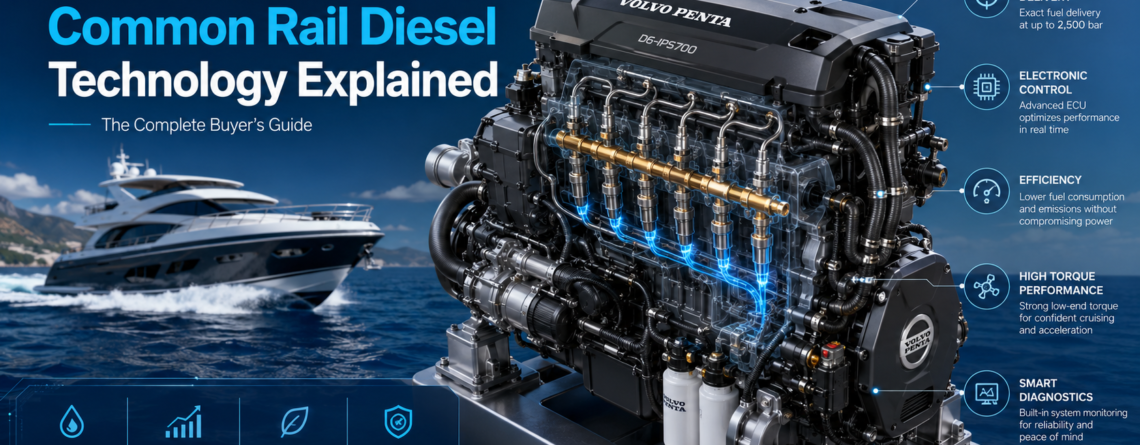
A common rail fuel-injection system stores diesel under high pressure in a shared fuel rail before electronically controlled injectors deliver it into each cylinder.
The easiest way to understand the system is to picture the rail as a pressurized reservoir.
All injectors receive fuel from that shared rail, but the engine control unit decides:
- When each injector opens
- How long it remains open
- How much fuel enters the cylinder
- Whether the fuel should be delivered through one or several injection events
The word “common” refers to the shared rail supplying all cylinders.
The major advantage is control.
In a conventional mechanical system, injection pressure and timing are closely connected to the mechanical operation of the pump and engine.
In a common-rail system, fuel pressure is created and stored separately. The electronic control system can then manage injection according to engine speed, temperature, load, throttle demand, and other operating information.
That allows the engine to adapt more precisely to changing conditions.
How a Volvo Penta Common Rail Marine Diesel Engine Fuel System Works
A modern marine diesel fuel system involves more than the injectors.
The principal components normally include:
- Fuel tank
- Primary fuel-water separator
- Low-pressure supply pump
- Fine fuel filter
- High-pressure fuel pump
- Common fuel rail
- Electronically controlled injectors
- Engine control unit
- Pressure, temperature, speed, and load sensors
- Fuel-return circuit
Step 1: Fuel Leaves the Tank
Diesel travels from the tank through the supply system.
Before it reaches the engine’s precision components, it must pass through filtration designed to remove water and contamination.
This step is critical because common-rail pumps and injectors operate with extremely fine tolerances.
Step 2: The High-Pressure Pump Compresses the Fuel
The supply pump feeds diesel to the high-pressure pump.
The high-pressure pump raises the fuel pressure and sends it into the common rail.
Step 3: The Rail Stores Pressurized Fuel
The rail provides a stable pressurized fuel supply to the injectors.
This means injection pressure does not have to be generated separately at the exact moment each cylinder requires fuel.
Step 4: Sensors Report Operating Conditions
Sensors monitor information such as:
- Engine speed
- Coolant temperature
- Intake conditions
- Rail pressure
- Throttle demand
- Engine load
The control unit evaluates this information continuously.
Step 5: The Injectors Deliver the Required Fuel
The engine control unit commands each injector to open at the appropriate moment.
Fuel delivery can be adjusted according to the engine’s immediate operating needs.
That precision is one reason an electronically controlled diesel engine can feel significantly more responsive than an older mechanical diesel.
Why Multiple Injection Events Matter
One advantage of electronic fuel injection is the ability to divide fuel delivery into multiple events.
The exact strategy varies by engine model, generation, operating condition, and calibration, but the system may use pilot, main, and additional injection events.
Pilot Injection
A small amount of fuel may be injected shortly before the main combustion event.
This helps begin combustion more gradually.
The practical benefits can include:
- Reduced diesel knock
- Smoother combustion
- Lower perceived engine noise
- Less harshness during acceleration
Main Injection
The main injection provides the fuel required to produce the requested power.
Its timing and quantity change according to engine load and throttle demand.
Additional Injection Events
Depending on the engine design and control strategy, additional injection events may be used to support combustion or emissions management.
It is important not to assume that every Volvo Penta engine uses the same number of injection events in every operating condition.
For example, archived Volvo Penta technical information for one D3 generation described a high-pressure common-rail system with piezoelectric injectors capable of multiple injections per working cycle.[1]
That is a model-specific example—not a universal specification for every Volvo Penta common-rail engine.
Common Rail vs Mechanical Diesel Injection
Common rail is newer and more electronically controlled, but that does not mean mechanical injection has no place in modern boating.
Both systems can be excellent when selected for the correct application.
| Feature | Common Rail Injection | Mechanical Injection |
|---|---|---|
| Fuel-pressure control | Electronically managed | Mechanically generated |
| Injection timing | Highly adjustable | Closely linked to pump and engine operation |
| Multiple injection events | Possible | Generally limited |
| Throttle response | Typically more refined | Traditional mechanical response |
| Combustion noise | Usually lower | Diesel knock may be more noticeable |
| Diagnostics | Electronic fault monitoring | Primarily mechanical testing |
| Fuel cleanliness sensitivity | Very high | Generally more tolerant |
| Repair complexity | Specialist tools often required | Often mechanically simpler |
| Control-system integration | Strong | Limited |
| Remote-area serviceability | Depends on diagnostic support | Often easier for general diesel technicians |
Reasons to Choose Common Rail
A common-rail engine may suit you when you prioritize:
- Smooth acceleration
- Lower noise
- Precise throttle response
- Electronic controls
- Integrated displays
- Modern diagnostics
- Compatibility with advanced propulsion functions
Reasons to Consider Mechanical Injection
Mechanical injection may remain attractive when you prioritize:
- Simpler field repairs
- Fewer electronic components
- Operation in remote locations
- Familiar mechanical servicing
- Reduced dependence on diagnostic software
Neither technology is universally superior.
The right choice depends on your vessel, cruising area, maintenance philosophy, and access to qualified service.
Which Volvo Penta Engines Use Common Rail?
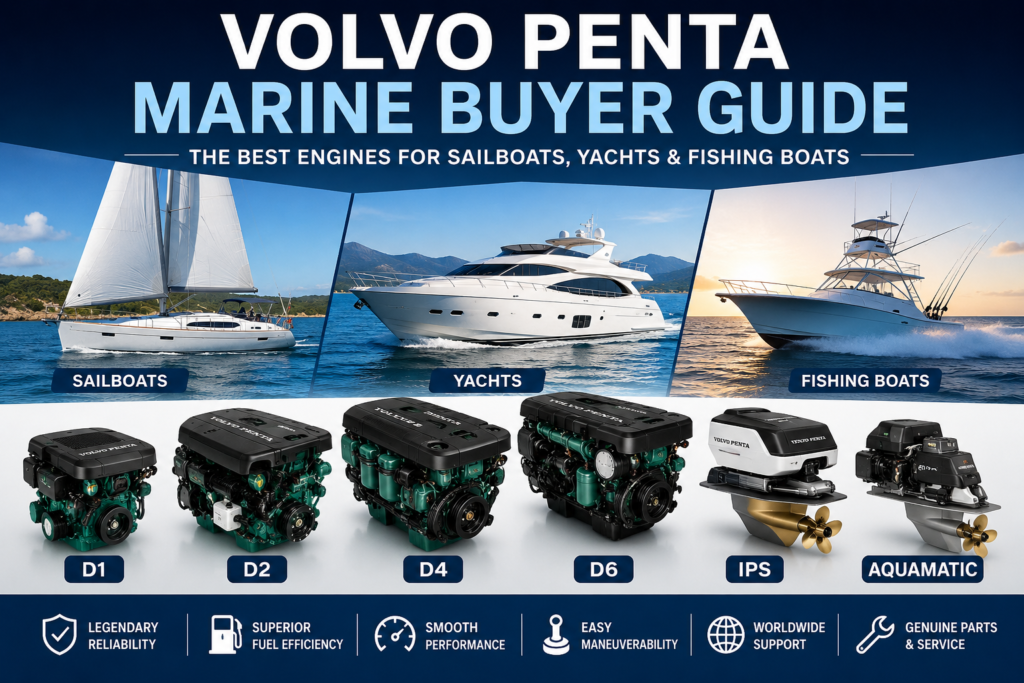
Not every Volvo Penta marine diesel uses the same fuel-injection system.
This distinction is important because buyers sometimes assume that every Volvo Penta diesel is common rail.
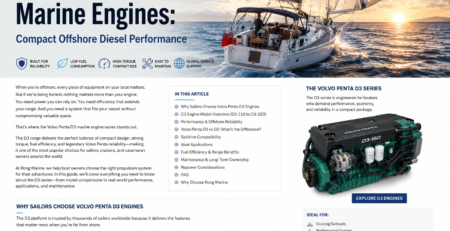
Volvo Penta D3 Marine Engines
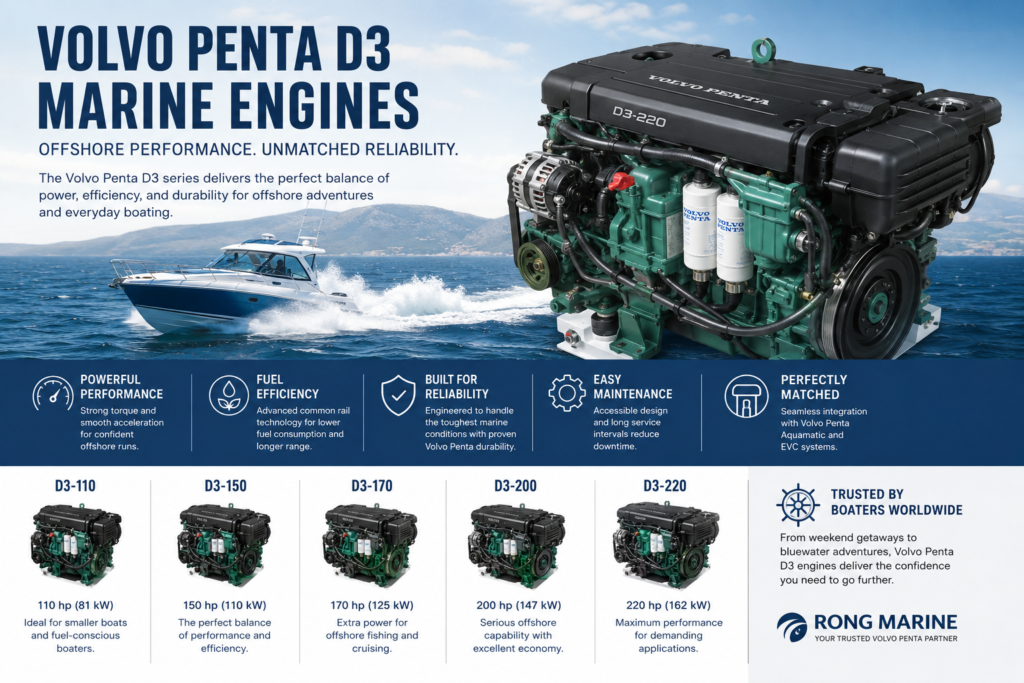
Archived Volvo Penta product information identifies the D3 as an inline five-cylinder, 2.4-liter diesel using common-rail injection with piezoelectric injectors.[1]
Depending on the generation and configuration, the Volvo Penta D3 Marine Engines have been used in:
- Sport cruisers
- Fishing boats
- Compact offshore vessels
- Aquamatic packages
- Inboard applications
- Repower projects
Because the D3 is now shown within Volvo Penta’s product archive, buyers considering a used or replacement D3 should verify:
- Exact model designation
- Production year
- Serial number
- Rated output
- Drive or transmission compatibility
- Control-system generation
- Parts and service availability
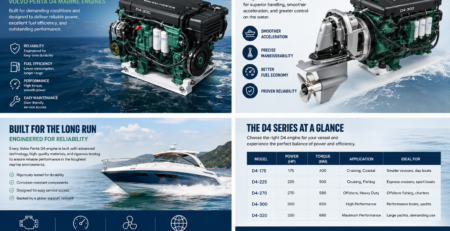
Volvo Penta D4 Marine Engines
The current Volvo Penta D4 Marine Engines are inline four-cylinder, 3.7-liter diesel engines using electronically controlled common-rail injection.
Volvo Penta identifies current D4 versions across several power ratings and describes the common-rail system as contributing to fuel efficiency.
The D4 is widely associated with:
- Offshore fishing boats
- Express cruisers
- Performance recreational boats
- Commercial vessels
- Aquamatic sterndrives
- Inboard installations
For owners who need strong marine torque without moving into a larger six-cylinder platform, the D4 can offer a practical balance of power, installation size, and electronic control.
Volvo Penta D6 Marine Engines
The current Volvo Penta D6 Marine Engines are inline six-cylinder, 5.5-liter common-rail diesels.
The D6 range is used across:
- Larger express cruisers
- Sportfishing boats
- Premium yachts
- Offshore vessels
- Inboard packages
- Aquamatic packages
- Volvo Penta IPS installations
The D6 illustrates how common rail can support higher-output marine applications while maintaining integrated electronic control.
Volvo Penta D8 and D11 Marine Engines
Current official Volvo Penta product information also identifies common-rail injection in the D8 and D11 marine families.
These larger engines extend common-rail technology into higher-output recreational and commercial applications.
Volvo Penta D2 Marine Engines: An Important Contrast
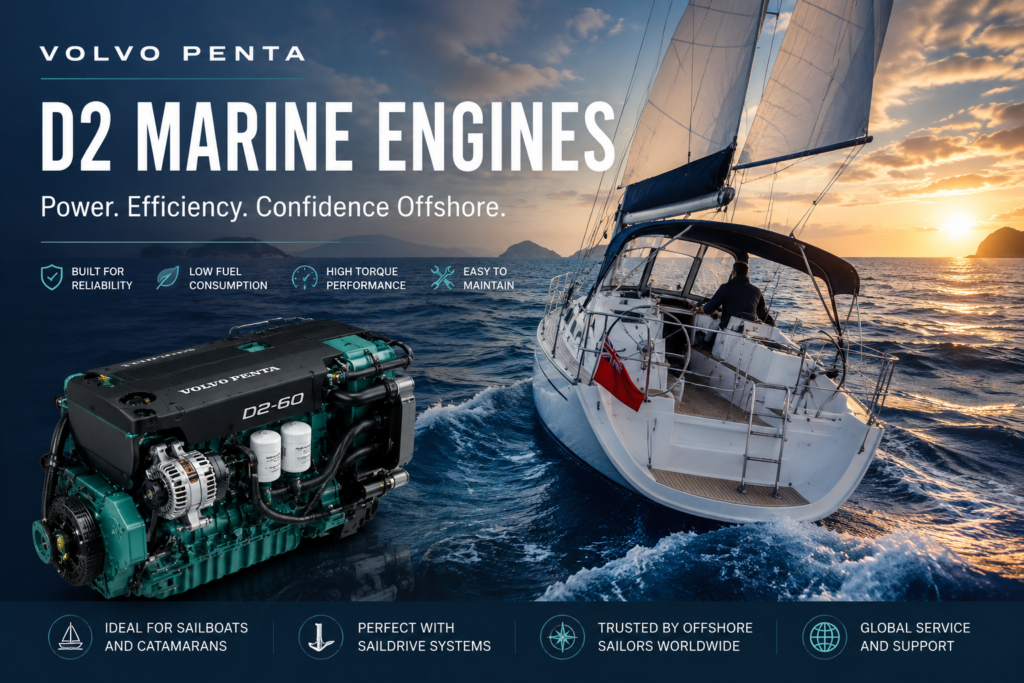
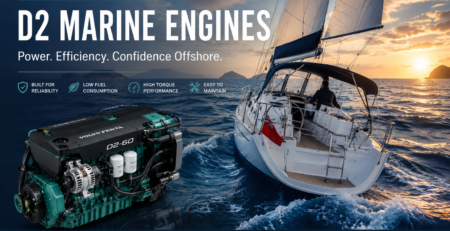
The current Volvo Penta D2 Marine Engines do not use common rail.
Volvo Penta describes the D2 as an inline four-cylinder, 2.2-liter diesel using a cam-driven inline injection pump.[6]
This does not make the D2 inferior.
It represents a different ownership philosophy.
The D2 may appeal to sailors and displacement-boat owners who value:
- Straightforward design
- Established mechanical servicing
- Dependable low-speed operation
- Reduced electronic complexity
- Auxiliary sailboat propulsion
The comparison between the D2 and common-rail D4 or D6 families demonstrates why engine selection should always begin with the boat’s application.
The Main Benefits of Volvo Penta Common Rail Technology
Precise Fuel Delivery
Common rail allows the control unit to adjust injection according to actual operating conditions.
The engine does not need the same fuel quantity when idling in a marina as it does when accelerating a loaded boat onto plane.
Precise fuel delivery helps the engine respond appropriately across those different demands.
Improved Throttle Response
Electronic control can provide a more immediate and predictable response when the operator moves the throttle.
This becomes valuable when:
- Accelerating onto plane
- Adjusting speed in waves
- Maneuvering around traffic
- Matching speed in a following sea
- Operating a heavily loaded vessel
Good throttle response is not simply about speed.
It improves control.
Smoother and Quieter Combustion
Controlled injection timing can soften the combustion event and reduce characteristic diesel knocking.
Owners moving from older mechanical engines often notice:
- Smoother idle
- Less harsh acceleration
- Reduced engine clatter
- Improved passenger comfort
Volvo Penta has linked common-rail injection in its D3 development information with reduced noise and smoother combustion.[1]
Cleaner Acceleration
Precise injection can support more controlled combustion and reduce visible smoke during normal operation.
However, no dealer should promise that a common-rail engine will never smoke.
Smoke may still result from:
- Fuel-system faults
- Injector wear
- Restricted airflow
- Turbocharger problems
- Incorrect engine loading
- Poor fuel
- Propeller mismatch
- Internal engine wear
Common rail improves control. It does not make the engine immune to mechanical or installation problems.
Fuel-Efficiency Potential
Volvo Penta states that the D4 common-rail system contributes to fuel efficiency.[2]
However, actual marine engine fuel efficiency depends on the entire vessel.
Factors include:
- Hull condition
- Propeller selection
- Drive or gearbox ratio
- Vessel weight
- Engine loading
- Cruising RPM
- Fuel-system health
- Maintenance quality
- Sea conditions
A common-rail engine cannot overcome a severely fouled hull or badly matched propeller.
Electronic Diagnostics
Electronic control gives technicians access to useful fault and operating data.
A proper diagnostic process may include:
- Reading stored fault codes
- Checking requested and actual rail pressure
- Reviewing sensor information
- Inspecting electrical supply
- Measuring fuel restriction
- Evaluating injector behavior
- Testing the engine under load
A fault code is evidence.
It is not always a final diagnosis.
What Owners May Notice After an Upgrade
To demonstrate experience without inventing customer testimonials, consider a representative repower scenario.
Representative Dealer Consultation
An owner has an older mechanical diesel with:
- Slow cold starting
- Heavy smoke during acceleration
- Delayed throttle response
- Increasing vibration
- Limited diagnostic information
The owner is considering a modern common-rail Volvo Penta replacement.
Before recommending an engine, a responsible dealer should evaluate:
- Hull type
- Vessel displacement
- Existing drive or gearbox
- Propeller
- Fuel-tank condition
- Electrical system
- Cooling and exhaust capacity
- Cruising-speed expectations
- Local service support
After a correctly engineered repower, the owner may notice:
- Faster starting
- More progressive throttle response
- Smoother acceleration
- Lower perceived noise
- Better helm information
- More predictable operation
Those improvements should not be attributed to common rail alone.
They result from the complete package:
- New engine
- Modern controls
- Correct installation
- Suitable propeller
- Healthy fuel system
- Proper commissioning
That distinction is essential for trustworthy dealer advice.
Common Rail and Fuel Economy: The Complete Picture
It is easy to say that common rail saves fuel.
A more accurate statement is:
Common rail can support efficient combustion, but the boat determines the final fuel consumption.
| Vessel or System Factor | Effect on Fuel Economy |
|---|---|
| Correct propeller | Helps the engine reach its intended operating range |
| Correct gearbox or drive ratio | Supports effective power transfer |
| Clean hull | Reduces resistance |
| Healthy injectors | Supports accurate fuel delivery |
| Clean air and fuel filters | Prevents restriction |
| Appropriate vessel loading | Reduces unnecessary power demand |
| Correct cruising RPM | Helps control fuel burn |
| Sound installation | Allows the engine to operate as designed |
Why Propeller Matching Matters
A powerful common-rail engine paired with the wrong propeller may fail to reach its rated operating range.
Possible consequences include:
- Excess engine load
- Poor acceleration
- Increased fuel consumption
- Higher exhaust temperatures
- Reduced performance
- Premature wear
The owner may blame the engine when the real cause is the propulsion setup.
That is why Rong Marine should position propulsion matching as part of every engine sale or repower consultation.
Volvo Penta Common Rail and EVC
Volvo Penta EVC, or Electronic Vessel Control, is the company’s drive-by-wire platform for controlling and monitoring propulsion functions.
Current Volvo Penta information describes EVC as integrating functions including:
- Throttle
- Gearshift
- Steering
- Trim
- Instrumentation
- Compatible maneuvering functions
Depending on the engine, drive, EVC generation, installed hardware, and software, an EVC package may support:
- Electronic shift and throttle
- Engine monitoring
- Alarms
- Joystick control
- Assisted Docking
- Dynamic Positioning
- Compatible displays
Not every EVC-equipped boat has every feature.
Before promising a control or maneuvering function, verify:
- EVC generation
- Engine compatibility
- Drive compatibility
- Required hardware
- Required software
- Vessel configuration
This protects both the customer and the dealer from costly misunderstandings.
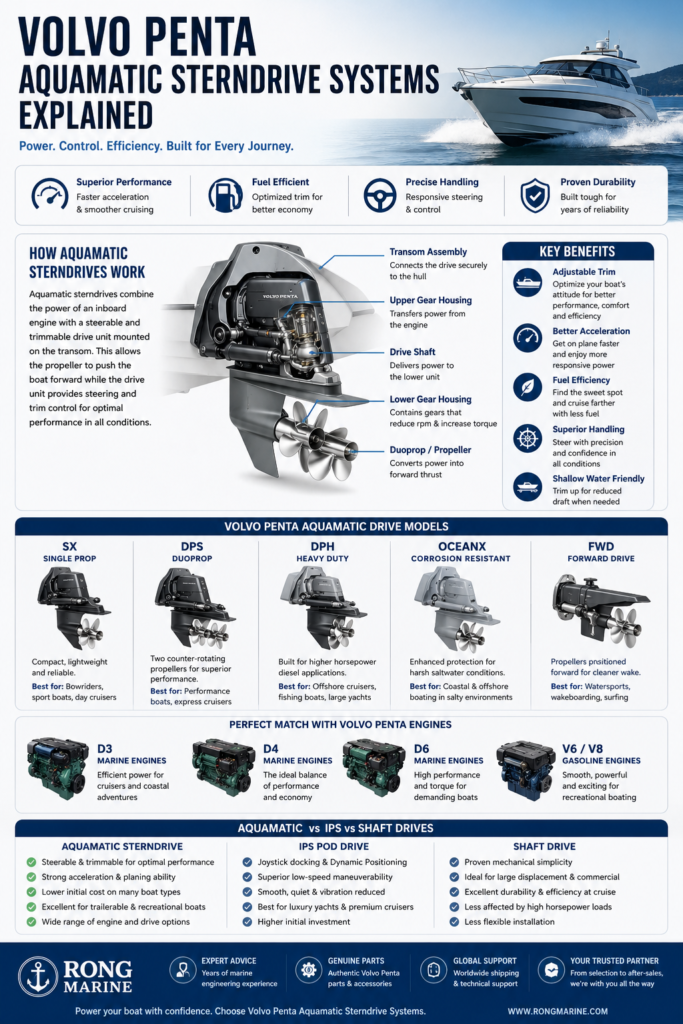
Common Rail With Aquamatic and IPS
Volvo Penta Aquamatic
Current D4 and D6 Aquamatic packages combine common-rail engines with integrated sterndrive systems.
A properly matched package may provide:
- Responsive acceleration
- Electronic throttle operation
- Strong midrange performance
- Efficient cruising
- Integrated engine and drive controls
The engine, drive, propellers, and hull must be matched correctly to achieve those benefits.
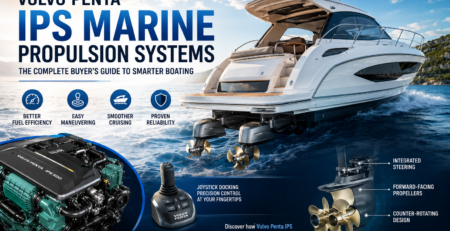
Volvo Penta IPS
Common-rail engines such as the D6 are also used in Volvo Penta IPS Marine Propulsion Systems.
Electronic integration supports coordination among:
- Engine
- Pod drive
- Helm controls
- Steering
- Compatible joystick functions
- Vessel displays
IPS may offer advanced maneuvering features, but exact availability depends on the package and control-system generation.
Common Rail Maintenance: Fuel Cleanliness Comes First
The greatest ownership advantage of common rail is precision.
The greatest ownership risk is also precision.
High-pressure pumps and injectors operate with extremely fine tolerances.
Contaminated diesel can cause expensive damage.
Sources of Fuel Contamination
Contamination may enter through:
- Poor-quality fuel
- Water condensation
- Damaged filler caps
- Corroded tanks
- Dirty transfer containers
- Microbial growth
- Inadequate filtration
- Long storage periods
Components at Risk
Contaminated fuel may damage:
- High-pressure pump
- Injectors
- Rail-pressure regulator
- Pressure-control valves
- Fuel sensors
- Precision sealing surfaces
Preventive Actions
Owners should:
- Inspect the tank
- Drain the water separator
- Replace filters on schedule
- Use the correct filter specification
- Investigate recurring water contamination
- Purchase fuel from reliable suppliers
- Avoid introducing dirt during servicing
- Address microbial growth professionally
An old contaminated tank can destroy a new engine’s fuel system.
Tank inspection should therefore be part of a responsible marine engine repower plan.
Warning Signs of a Fuel-System Problem
Potential symptoms include:
- Hard starting
- Rough idle
- Power loss
- Excess smoke
- Increased fuel consumption
- Engine hesitation
- Fuel-pressure alarms
- Uneven combustion
| Symptom | Possible Areas to Inspect |
|---|---|
| Hard starting | Battery voltage, air ingress, filters, fuel pressure |
| Loss of power | Supply restriction, injector issue, sensor fault, engine load |
| Rough idle | Injector balance, fuel quality, sensor input, compression |
| Excess smoke | Injectors, airflow, turbocharger, loading, fuel quality |
| Rail-pressure fault | Filters, supply pump, high-pressure pump, pressure control |
| High fuel use | Injector condition, hull, propeller, load, operating RPM |
These are possible inspection areas—not confirmed diagnoses.
Several unrelated problems can produce similar symptoms.
Testing should come before replacing expensive parts.
Critical High-Pressure Fuel Safety
Never loosen, disconnect, or test a common-rail fuel line while the system is pressurized.
High-pressure injection injuries can force fuel beneath the skin and may appear deceptively minor at first. They require urgent medical evaluation and can result in severe tissue damage.
Common-rail repairs should be completed by trained technicians using:
- Correct depressurization procedures
- Manufacturer service information
- Suitable protective equipment
- Approved diagnostic tools
- Properly clean working conditions
This is not an appropriate system for improvised testing.
Common Rail Repair Costs: The Honest Ownership Picture
Common rail provides real performance and control advantages, but repairs can be more expensive than on a basic mechanical system.
Potentially costly components include:
- Electronic injectors
- High-pressure pump
- Rail-pressure sensor
- Pressure regulator
- Engine control unit
- Wiring harnesses
- Control modules
Diagnosis may require:
- Manufacturer-compatible software
- Fuel-pressure testing
- Injector testing
- Electrical testing
- Calibration
- Programming
- A qualified technician
This is not a reason to avoid common rail.
It is a reason to prioritize prevention.
Clean fuel, stable battery voltage, scheduled filter replacement, and early diagnosis protect the system far more effectively than waiting for complete failure.
Buying a Used Volvo Penta Common Rail Engine
A used common-rail engine should not be judged by paintwork alone.
Ask for evidence.
Questions to Ask the Seller
- What is the engine model and serial number?
- How many operating hours are recorded?
- Is the service history documented?
- Has the fuel system experienced water contamination?
- Have injectors been tested or replaced?
- Has the high-pressure pump been repaired?
- Are diagnostic records available?
- Was the engine professionally winterized?
- Which controls and displays are included?
- Can the engine be tested under load?
Recommended Pre-Purchase Checks
A professional inspection should include:
- Cold start
- Diagnostic scan
- Smoke assessment
- Oil and coolant inspection
- Charging-voltage test
- Fuel-system inspection
- Sea trial or dynamometer test
- Full-load RPM verification
- Gearbox or drive inspection
- Serial-number verification
A brief no-load run does not prove that an engine is healthy.
Repowering With a Common Rail Volvo Penta Engine
A common-rail repower can improve the boating experience, but only when the complete installation is evaluated.
| Repower Area | Why It Matters |
|---|---|
| Fuel tank | Contamination can damage precision components |
| Fuel supply and return | Must meet the new engine’s requirements |
| Electrical system | Control modules require stable voltage |
| Wiring and controls | New harnesses and displays may be necessary |
| Engine mounts | Must support the engine and preserve alignment |
| Cooling system | Must provide sufficient flow |
| Exhaust system | Must suit the new engine output |
| Gearbox or drive | Ratio and torque compatibility are essential |
| Propeller | Must match the new engine and vessel |
| Service access | Filters and components must remain reachable |
The Most Overlooked Repower Risk
An owner may assume:
“The existing tank supplied the old engine, so it will supply the new one.”
That assumption can be expensive.
An older mechanical diesel may tolerate contamination that rapidly damages a modern high-pressure fuel rail system.
Tank condition must be assessed before the new engine is commissioned.
Is Common Rail Right for Your Boat?
Common Rail May Be Right When You Value:
- Smooth power delivery
- Electronic throttle and shift
- Strong acceleration
- Modern diagnostics
- Integrated displays
- Lower perceived noise
- Compatibility with advanced propulsion functions
Mechanical Injection May Be Better When You Value:
- Simpler field servicing
- Fewer electronic components
- Remote-area repairability
- Traditional mechanical controls
- Reduced dependence on specialist software
The best technology is the one that fits your real operating environment.
A modern common-rail system may be excellent for an express cruiser operating near a strong dealer network.
A mechanically injected engine may provide greater peace of mind for a long-range cruising sailboat operating in isolated regions.
Common Buyer Mistakes
Choosing by Horsepower Alone
Horsepower cannot correct poor engine-to-hull matching.
Ignoring the Fuel Tank
A contaminated tank can damage a new engine before it completes its first season.
Buying Untested Used Injectors
Injectors require proper testing. Appearance does not reveal leakage, calibration, or spray quality.
Replacing Parts Based Only on a Fault Code
A code identifies an affected circuit or condition. It does not always prove that the named component has failed.
Assuming Every Volvo Penta Diesel Uses Common Rail
The current D4 and D6 use common rail, while the D2 uses a cam-driven inline injection pump.[2][3][6]
The exact model and serial number should always be checked.
Frequently Asked Questions
What is Volvo Penta common rail diesel technology?
It is an electronically controlled system that stores diesel under high pressure in a shared rail and delivers carefully measured fuel through individual injectors.
Which Volvo Penta engines use common rail?
Current official information identifies common rail in families including the D4, D6, D8, and D11. Archived D3 information also identifies common-rail injection.
Is the Volvo Penta D2 common rail?
No. Volvo Penta identifies the current D2 as using a cam-driven inline injection pump.[6]
Is common rail more fuel efficient?
It can support efficient combustion, but actual fuel use depends on vessel weight, hull condition, propeller selection, drive ratio, operating RPM, and maintenance.
Are common-rail marine engines reliable?
Yes, provided they receive clean fuel, correct maintenance, stable electrical power, and qualified technical support.
Why are common-rail engines quieter?
Controlled injection timing and pilot injection can reduce the harshness of the combustion event.
Can water damage a common-rail engine?
Yes. Water can damage injectors, pumps, valves, sensors, and other precision components.
Can I repair common-rail injectors myself?
Injector testing and high-pressure repairs should be performed by qualified specialists because of the precision and safety risks involved.
Can an older boat be repowered with common rail?
Yes, but the fuel, electrical, cooling, exhaust, controls, mounts, drive, and propeller must be evaluated together.
Is common rail better for offshore boating?
It can provide excellent performance and monitoring, but offshore owners must also consider fuel quality and access to qualified diagnostic support.
Why Boat Owners Choose Rong Marine
Rong Marine helps customers evaluate Volvo Penta marine engines as complete propulsion solutions.
Support may include:
- Engine selection
- Propulsion matching
- Volvo Penta D3 Marine Engines
- Volvo Penta D4 Marine Engines
- Volvo Penta D6 Marine Engines
- Aquamatic packages
- IPS packages
- Repower planning
- Genuine Volvo Penta parts
- Export and worldwide delivery support
The responsible approach is not to recommend common rail simply because it is modern.
The correct approach is to determine whether it matches:
- The boat
- The cruising area
- The available service network
- The owner’s maintenance expectations
- The required performance
- The long-term budget
Final Thoughts
Volvo Penta common rail diesel technology provides a highly precise approach to marine fuel delivery.
Its potential benefits include:
- Smoother combustion
- Responsive acceleration
- Lower perceived noise
- Cleaner normal operation
- Useful electronic diagnostics
- Integration with modern vessel controls
Those benefits come with clear responsibilities:
- Maintain clean fuel
- Replace filters correctly
- Control water contamination
- Protect battery and charging systems
- Diagnose faults before replacing parts
- Use qualified technicians for high-pressure repairs
- Match the engine to the hull and propulsion system
The best engine is not automatically the newest or most sophisticated one.
It is the engine that matches the vessel, cruising environment, service access, and owner’s long-term expectations.
That is the principle that should guide every Rong Marine recommendation—and every confident engine purchase.


Leave a Reply